Homosexuality
Summary
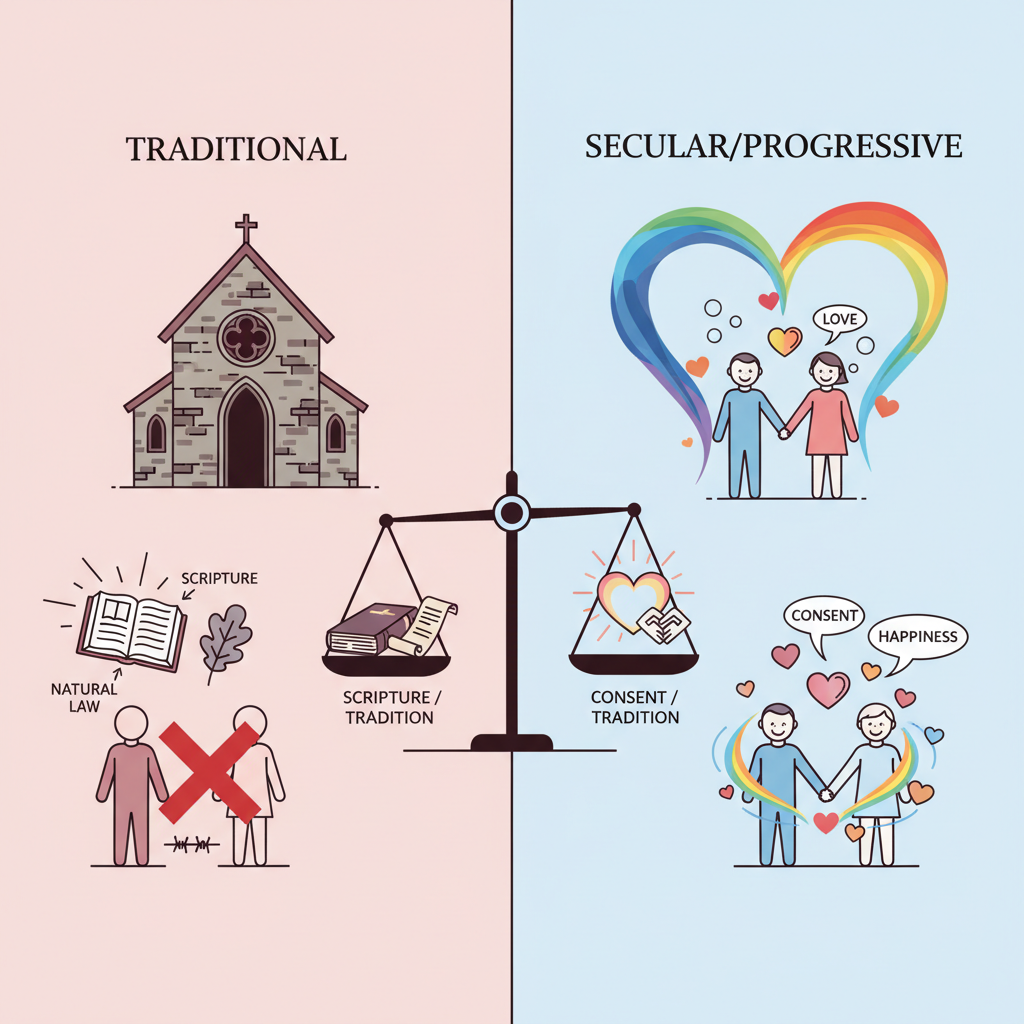
Homosexuality is sexual and romantic attraction to people of the same gender. This topic in sex ethics examines whether same-sex relationships and sexual acts are morally permissible. Traditional Religious Views condemn homosexuality: the Bible explicitly forbids homosexual acts (Leviticus 18:22, Romans 1:26-27); Natural Law says sex has the purpose of procreation, which is impossible in same-sex relations, making them 'contrary to nature'; the Roman Catholic Church calls homosexuality 'intrinsically disordered' and urges gay people to remain celibate. Secular and Progressive Views support homosexuality: Kantian Ethics argues same-sex relationships can express mutual respect, consent, and commitment; Utilitarianism holds that homosexuality maximizes happiness and reduces suffering; Modern Christian Views emphasize that God loves all people made in His image and justice demands acceptance.
Detailed Explanation
Traditional Religious Argument Against Homosexuality
1. Biblical Foundation
Old Testament:
- Leviticus 18:22: 'You shall not lie with a male as with a woman; it is an abomination'
- Sodom and Gomorrah: Destroyed by God partly for homosexual practice (though scholars debate whether this was the primary sin)
New Testament:
- St. Paul (1 Corinthians 6:9-10): Lists 'men who practice homosexuality' among those who 'will not inherit the kingdom of God'
- Romans 1:26-27: 'Men committed shameful acts with other men' as a result of abandoning God
Traditional Christian Interpretation:
The traditional Christian reading is that homosexual acts are explicitly and unambiguously forbidden by Scripture.
2. Natural Law Argument
The Telos (Purpose) of Sex:
Sex has two purposes:
- Procreative: To create children
- Unitive: To bond a couple together
The Problem with Homosexuality:
- Same-sex intercourse cannot produce children
- It uses sexual organs in a way contrary to their biological purpose
- Therefore, it is 'contrary to nature' and immoral
Aquinas's View:
All sex outside marriage is wrong; homosexual sex doubly so because it can never be procreative. Even if two people of the same sex loved each other, sex between them would still be immoral because it violates the procreative purpose.
The Counter-Argument:
Critics note that if love and mutual support are placed at the center of marriage (not just procreation), then same-sex couples meet this standard. Additionally, sterile heterosexual couples can marry and have sex without procreating—why not same-sex couples?
3. Augustine's 'Original Sin' Argument
Augustine's Teaching:
- Sexual desire itself is a consequence of original sin and humanity's fallen state
- Even within marriage, sex motivated purely by lust (not by the desire for children) is sinful
- Homosexual acts are 'giving in to original sin in a depraved and disordered way'
Liberal Christian and Progressive Views (Support)
1. Historical and Contextual Reading of Scripture
The Argument:
- The Bible must be read in historical context, not applied literally to modern situations
- The condemnations in Leviticus and Paul's letters may have targeted pagan temple prostitution or exploitative practices, not consensual loving relationships
- Jesus is silent on homosexuality; His emphasis is on love and justice
Scholar's View (John Boswell):
- Only Leviticus 18:22 directly prohibits homosexual acts, and this was Old Testament ceremonial law not binding on Christians
- The Greek words Paul used (in 1 Corinthians 6:9) are ambiguous and may not refer to homosexuality per se
Progressive Christian Conclusion:
The spirit of Scripture is justice and compassion for the marginalized. Excluding gay people from marriage violates this spirit.
2. All People Are Made in God's Image
The Argument:
- Genesis 1:27: 'God created them male and female in His own image'
- All people—including gay and lesbian people—have inherent dignity
- To deny gay people the right to marry and express love is to diminish their human dignity
- Justice demands acceptance of same-sex relationships
3. Modern Understanding of Sexual Orientation
The Argument:
- Sexual orientation is not a choice—it's biologically determined
- To demand that gay people remain celibate for life is to demand they live in loneliness and deprivation
- This is compassionless and unjust
Kantian Ethics Approach (Generally Supporting)
The Core Principle:
Sexual relationships must involve mutual consent, respect, and commitment, avoiding objectification and treating partners as ends in themselves.
Applied to Homosexuality:
- If two people of the same gender consent, respect each other, and commit to each other, their relationship is ethically permissible
- The gender of the partners is irrelevant; what matters is consent and respect
- Homosexual relationships can express love, commitment, and mutual flourishing—values Kant would support
Concern:
Sex driven purely by lust or personal gain (same-sex or opposite-sex) is problematic because it objectifies the other person. But committed same-sex partnerships express genuine respect and commitment.
Utilitarian Ethics Approach (Generally Supporting)
The Core Principle:
Actions are moral if they maximize happiness and reduce suffering.
Applied to Homosexuality:
- Same-sex relationships between consenting adults increase happiness for those couples
- Restricting homosexuality causes suffering (depression, anxiety, suicide among gay youth)
- Therefore, allowing and accepting homosexuality maximizes overall happiness
Additional Benefits:
- Legalizing same-sex marriage increases social stability because marriage promotes commitment and responsibility
- It does not harm heterosexual marriages or opposite-sex people
Concerns:
Some argue that same-sex marriage 'alters the meaning of marriage' in society, potentially causing harm. But utilitarians counter: the benefits to gay couples far outweigh any abstract concerns about 'traditional marriage'.
Catholic Church Official Position
Doctrine:
- Homosexuality is an 'intrinsically disordered' condition
- Having homosexual inclinations is not sinful (people don't choose them)
- Acting on homosexual inclinations through sexual acts is immoral
- Gay and lesbian Catholics are called to chastity and celibacy
Pastoral Care:
The Church says it will treat gay people with 'respect, compassion, and sensitivity'. But this compassion does not extend to blessing same-sex unions or affirming homosexual practice.
Key Debates
1. Is the Bible's Teaching Clear?
- Traditionalists: Yes—Leviticus 18:22, Romans 1:26-27, and 1 Corinthians 6:9 clearly condemn it
- Progressives: The Bible must be read historically; these verses may target temple prostitution or pagan practices, not loving relationships
2. Does Natural Law Condemn Homosexuality?
- Traditionalists: Yes—sex's purpose is procreation; same-sex sex fails this purpose
- Progressives: If love and mutual support are the primary purpose (not just procreation), same-sex relationships qualify
3. Is Sexual Orientation a Choice?
- Modern Understanding: No—orientation is biologically determined
- Ethical Implication: If it's not a choice, it's unjust to demand lifelong celibacy
4. Can Same-Sex Marriage Be Consistent with Religious Belief?
- Progressive Yes: Accepting LGBTQ+ people and marriage is consistent with Jesus's message of love and justice
- Traditional No: Marriage is between man and woman; accepting same-sex marriage betrays scriptural teaching
Scholarly Perspectives
Traditional Religious Perspective
"The Bible explicitly condemns homosexual acts in multiple places—Leviticus 18:22, Romans 1:26-27, and 1 Corinthians 6:9. Moreover, Natural Law teaches that sex has the purpose of procreation, which is impossible in same-sex relations. Homosexual acts therefore violate both Scripture and the natural order of creation. While Christians must treat gay people with compassion, they cannot affirm homosexual practice as morally acceptable."
Source: Traditional Christian and Catholic sexual ethics
Context: This represents the conservative religious position grounded in biblical interpretation and Natural Law theory.
Progressive/Secular Perspective
"Sexual ethics must be judged by principles of consent, mutual respect, and the promotion of human flourishing—not by arbitrary rules based on outdated interpretations of Scripture. Same-sex relationships between consenting adults express love, commitment, and mutual respect. To deny gay people the right to marry is to deny them dignity and happiness, violating both Kantian and utilitarian ethical principles. Justice and compassion demand acceptance."
Source: Progressive Christian and secular ethical perspectives
Context: This represents the modern, inclusive approach grounded in respect for persons and maximization of happiness.
Key Takeaways
Traditional Religious View
Homosexuality forbidden by Bible and Natural Law; sex's purpose is procreation; same-sex acts are 'contrary to nature'.
Kantian Ethics View
Same-sex relationships permissible if consensual and respectful; gender irrelevant to moral evaluation of relationships.
Utilitarian View
Homosexuality permissible because it maximizes happiness and reduces suffering; restricting it causes harm.
Progressive Christian View
All people have dignity; justice demands acceptance; Bible must be read historically; Jesus's message is love and justice for all.
Central Ethical Question
Is ethics determined by divine command and natural purpose, or by consent, respect, and consequences?
Contemporary Reality
Most secular societies and progressive churches now accept same-sex relationships; traditional religions continue to oppose them based on Scripture and Natural Law.
Quick Reference: Ethical Perspectives on Homosexuality
| Theory | Position | Reasoning |
|---|---|---|
| Traditional Religion | Forbidden | Bible condemns it; violates procreative purpose |
| Natural Law | Forbidden | Same-sex sex cannot procreate; contrary to nature |
| Catholic Church | Forbidden (but compassionate) | Intrinsically disordered; call to celibacy |
| Kantian Ethics | Permissible | If mutual consent, respect, and commitment present |
| Utilitarianism | Permissible | Maximizes happiness; reduces suffering |
| Situation Ethics | Depends on context | If agape love is present |
| Progressive Christianity | Permissible/Required | Justice and dignity demand acceptance |