Topic 1 of Conscience
Aquinas' Theological Approach to Conscience
Summary
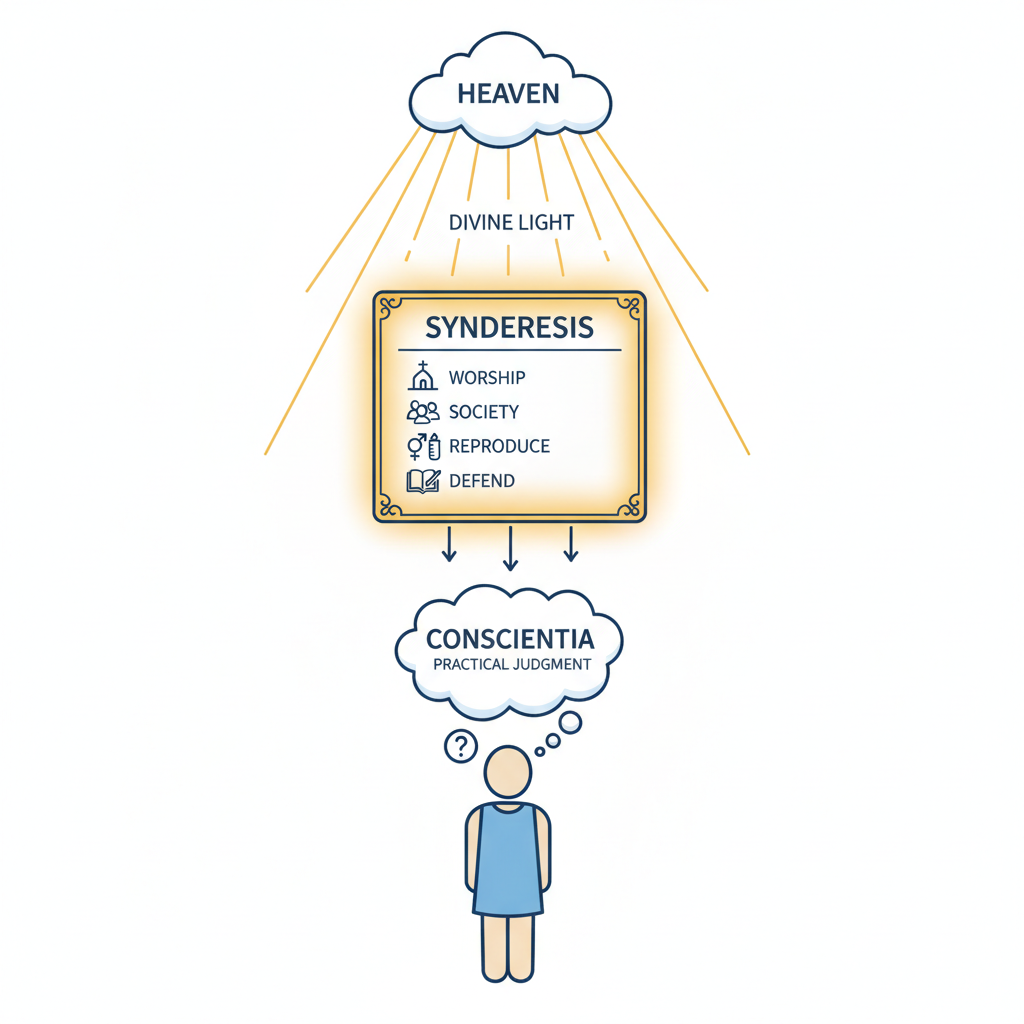
Aquinas' theological approach sees conscience as reason applying God's Natural Law. He divides conscience into two parts: Synderesis - an infallible inner principle from God that directs us toward good and away from evil, like a "moral compass" that always points to the primary precepts (worship God, preserve life, reproduce, educate, live in society); and Conscientia - fallible practical judgment where we apply synderesis to specific situations (this is where mistakes happen). Aquinas says conscience is binding - we must follow it, even if it's wrong (though we're not guilty if we couldn't have known better). Conscience "witnesses, binds, and torments" us through guilt when we disobey.
What is Aquinas' Theological Approach?
Definition
Aquinas views conscience as reason's application of God's Natural Law to human actions. It's a psychological process grounded in God's design of human nature.
Unlike purely secular approaches to conscience, Aquinas roots moral knowledge in the divine. Conscience is not arbitrary or culturally constructed—it reflects the rational structure God built into creation. Through conscience, humans participate in God's eternal law by applying their reason to discover what is right and wrong.
The Two Components of Conscience
Aquinas distinguishes between two aspects of conscience that work together to guide moral action. This distinction explains both our consistent moral intuitions and our ability to make mistakes in applying them.
1. Synderesis (The Infallible Foundation)
What it is
- • An innate, infallible habit of practical reason that grasps the first principles of natural law.
- • Given by God to all humans as part of our rational nature.
- • Always directs us toward good and away from evil.
The Synderesis Rule
"Do good and avoid evil" - This is the fundamental principle that cannot be mistaken or lost from the human mind.
The Primary Precepts (Five Natural Inclinations)
Aquinas identifies five primary precepts that flow from synderesis:
- Worship God - our natural inclination toward the transcendent
- Live in an ordered society - our social nature
- Reproduce - our biological drive to continue the species
- Educate/Learn - our intellectual nature
- Defend/preserve human life - our instinct for survival and protection of innocent life
Memorize with WORLD
- Worship God
- Ordered society
- Reproduction
- Learning/Education
- Defence of the innocent
2. Conscientia (The Fallible Application)
What it is
- • The active process of applying synderesis and the primary precepts to specific situations.
- • Forms secondary precepts - specific moral judgments about particular actions.
- • Fallible - can make mistakes due to ignorance, bad habits, or corrupt culture.
How it Works
- 1. Synderesis provides the primary precepts (e.g., "preserve human life")
- 2. Conscientia applies this to a situation (e.g., "euthanasia ends human life")
- 3. Conscientia forms a secondary precept (e.g., "euthanasia is wrong")
Example: Euthanasia
- Primary precept: "Preserve human life"
- Application: Euthanasia ends a human life
- Secondary precept: "Euthanasia is wrong"
The Binding Nature of Conscience
Aquinas' Key Claim
Conscience is binding - it is always wrong to disobey your conscience, even if it's mistaken.
Two Types of Ignorance
Invincible Ignorance: Couldn't have known better (not your fault)
Example: You genuinely didn't know the primary precept applied to this situation
Result: Not guilty, not morally blameworthy
Vincible Ignorance: Could have known better but didn't (your fault)
Example: You were too lazy to think carefully, or your conscience was corrupted by bad habits
Result: Guilty and morally blameworthy
How Conscience "Witnesses, Binds, and Torments"
Aquinas describes three functions
- Witnesses: Conscience tells us what is right and wrong before we act
- Binds: Conscience creates a moral obligation we must follow
- Torments: Conscience causes guilt (remorse) when we disobey
Mechanism
Our reason knows the moral law through synderesis. When we act against it, we experience guilt because we deep down know we've done wrong. This guilt is not merely psychological discomfort but a rational recognition that we have violated the natural law inscribed in our nature by God.
Real Goods vs. Apparent Goods
Real Goods
Actions that truly fulfill our natural telos (purpose) and align with primary precepts.
Apparent Goods
Actions that seem good due to faulty reasoning but are actually bad.
Example
Someone might reason that euthanasia is compassionate (apparent good), but it's actually wrong because it violates the primary precept of preserving life (real good).
Strengths of Aquinas' Approach
Respects Human Rationality
- • Conscience develops through reason and education, not just blind obedience.
- • Allows for moral growth and sophistication.
Accounts for Guilt
- • Explains why we feel guilty when we do wrong—our reason tells us we've violated God's law.
Biblical Foundation
- • Rooted in Scripture (Romans 2:15) and Christian tradition.
- • Connects conscience to God's design of human nature.
Flexibility Within Structure
- • Infallible synderesis provides firm foundation, but conscientia allows for application to complex situations.
Weaknesses of Aquinas' Approach
Verification Problem
- • How do we know synderesis is from God and infallible?
- • Can't be empirically verified.
Moral Disagreement
- • If synderesis is infallible, why do people have different moral intuitions?
- • Why do some people intuit that euthanasia is permissible while others don't?
Cultural Relativity
- • Conscientia can be corrupted by culture, but Aquinas doesn't fully explain how to distinguish corrupted from correct conscience.
The Bindingness Problem
- • If conscience is mistaken, why must we still follow it?
- • Seems irrational to follow a wrong judgment.
Scholarly Perspectives
"The first practical principles... belong to a special natural habit which we call 'synderesis'... Synderesis is said to incite to good, and to murmur at evil, inasmuch as through first principles we proceed to discover, and judge of what we have discovered. Conscience is the application of knowledge to our acts, that we may judge whether they are right or wrong."
Aquinas defines synderesis as the innate habit grasping first principles, and conscience as the application of these principles to judge actions. This fundamental distinction allows Aquinas to explain both the universality of basic moral knowledge and the diversity of moral judgments about particular cases.
"Every conscience, whether right or wrong, whether the issue of right reason or perverted, binds. It binds us in such a way that he who disregards conscience commits sin. The conscience is binding, even when it is mistaken."
Aquinas's controversial claim that conscience always binds, even when mistaken, reflects his view that following conscience is how we fulfill our duty to God's law. To act against conscience is to reject what reason presents as morally required, which is always a failure of the will regardless of whether reason itself has erred.
Key Takeaways
Two Parts: Synderesis (infallible foundation) + Conscientia (fallible application) = Conscience.
WORLD: Worship, Ordered society, Reproduction, Learning, Defence of innocent = primary precepts.
Synderesis is infallible: Always directs us to good; can't be lost from the human mind.
Conscientia is fallible: Can make mistakes due to ignorance, bad habits, culture.
Conscience binds: Must always be obeyed, even if mistaken (though not blameworthy if invincibly ignorant).
Real vs. Apparent Goods: Real goods fulfill our telos; apparent goods seem good due to faulty reasoning.
Strengths: Respects rationality, accounts for guilt, biblical foundation, flexible within structure.
Weaknesses: Verification problem, moral disagreement, cultural relativity, bindingness problem.
Quick Reference: Aquinas' Conscience at a Glance
| Component | Description | Status |
|---|---|---|
| Synderesis | Innate habit grasping first principles (do good, avoid evil) | Infallible |
| Primary Precepts | Five natural inclinations (Worship, Order, Reproduce, Learn, Defend) | Infallible |
| Conscientia | Application of principles to specific situations | Fallible |
| Secondary Precepts | Specific moral judgments (e.g., "euthanasia is wrong") | Fallible |
| Conscience | Whole process (synderesis + conscientia) | Binding (must be obeyed) |
| Guilt | Torment when we disobey conscience | Natural result of violating synderesis |