Aquinas' development of Aristotle's telos
Summary
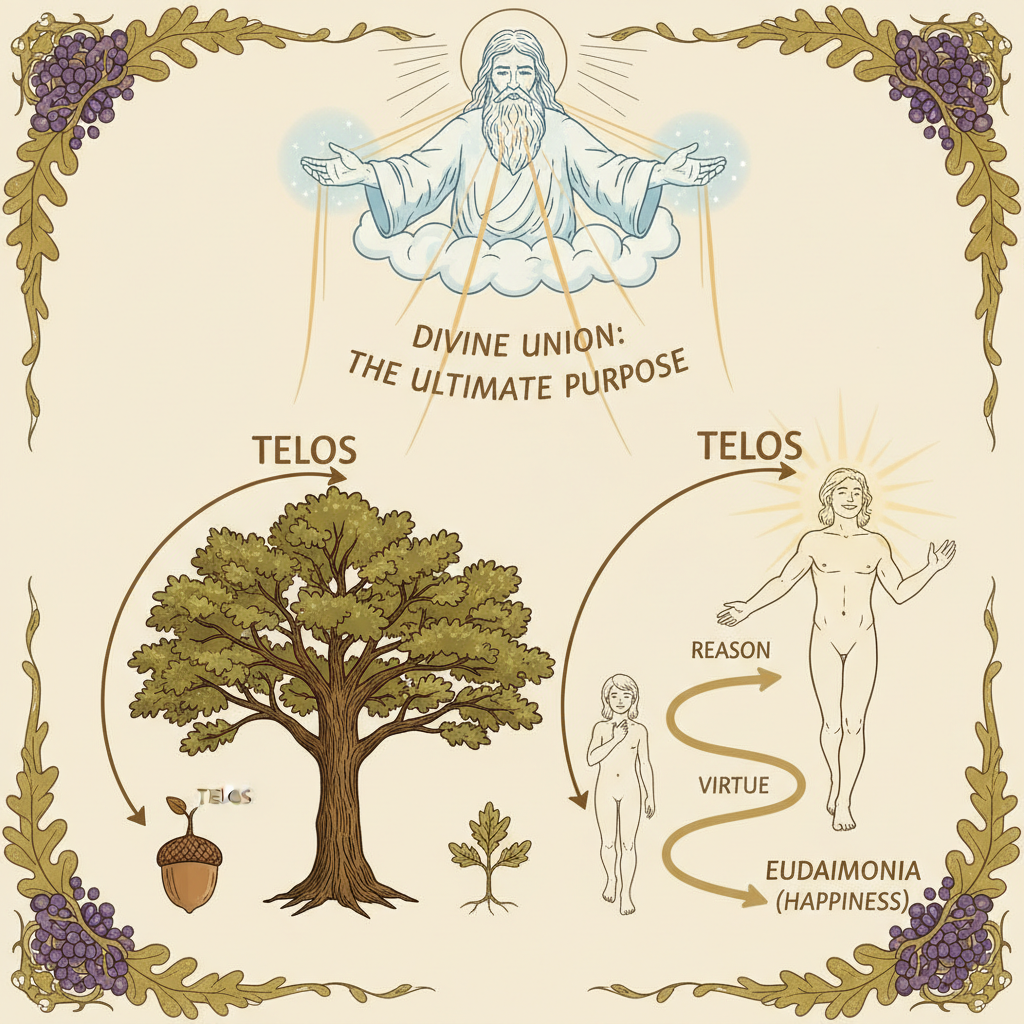
Aristotle (384-322 BCE) developed the concept of telos (Greek for "end," "goal," or "purpose")—the idea that everything has a natural purpose it strives toward. An acorn's telos is to become an oak tree; an eye's telos is to see; a human's telos is eudaimonia (flourishing/happiness) achieved through living virtuously according to reason. Thomas Aquinas (1225-1274) Christianised Aristotle's teleology: he agreed everything has a telos, but added that God designed all purposes as part of His eternal plan. For Aquinas, the ultimate human telos is not just earthly flourishing but eternal union with God—the Beatific Vision. We can discover our telos through reason (not just Scripture), because God implanted knowledge of natural law within human nature. This is the foundation of Natural Law ethics: good = fulfilling your God-given purpose; evil = failing to fulfill it.
Detailed Explanation
Aristotle's Original Concept of Telos
What Is Telos?
- Telos (τέλος) is Greek for "end," "goal," "purpose," or "final cause".
- Aristotle believed that everything in the natural world has an inherent purpose—a goal it naturally strives toward.
Aristotle's Four Causes
Aristotle explained everything through four types of causation:
| Cause | Question It Answers | Example (a Statue) |
|---|---|---|
| Material Cause | What is it made of? | Marble |
| Formal Cause | What is its shape/form? | Human shape |
| Efficient Cause | What made it? | The sculptor's chisel |
| Final Cause (Telos) | What is it for? What's its purpose? | To honor the gods |
Aristotle's Key Insight:
- The final cause (telos) is the most important cause.
- To truly understand something, you must know what it's for.
Examples of Telos in Nature
The Acorn:
- An acorn's telos is to grow into an oak tree.
- The acorn is directed by its nature toward this goal.
- When it achieves its telos (becomes an oak), it is fulfilling its nature.
The Eye:
- An eye's telos is to see.
- A good eye is one that sees well (fulfills its purpose).
- A bad eye is one that doesn't see well (fails its purpose).
A Knife:
- A knife's telos is to cut.
- A good knife cuts well; a bad knife doesn't.
Eudaimonia: The Human Telos
What Is Eudaimonia?
- For Aristotle, the human telos is eudaimonia (εὐδαιμονία).
- Eudaimonia is often translated as "happiness," but it means something deeper:
- Flourishing
- Well-being
- Living well
- Fulfillment of human nature
How Do Humans Achieve Eudaimonia?
According to Aristotle:
1. By Using Reason:
- What distinguishes humans from other animals is our capacity for reason.
- Therefore, the human telos is to live according to reason.
2. By Cultivating Virtue:
- Eudaimonia is achieved through cultivating virtues (excellences of character).
- Virtues include: courage, justice, temperance, wisdom.
- A virtuous person uses reason to find the "golden mean" between extremes.
3. By Living in Community (Polis):
- Humans are social animals who flourish in community.
- The polis (city-state) provides the context for human flourishing.
Aquinas' Christianisation of Aristotle's Telos
Aquinas' Relationship to Aristotle
The Historical Context:
- Thomas Aquinas (1225-1274) was a medieval Catholic theologian and philosopher.
- He called Aristotle simply "The Philosopher"—showing immense respect.
- Aquinas saw no conflict between Aristotle's philosophy and Christian faith.
- He sought to synthesize Greek philosophy with Christian theology.
What Aquinas Kept from Aristotle
1. The Concept of Telos:
- Aquinas agreed with Aristotle that everything has a purpose (telos).
- The acorn still has the telos of becoming an oak.
- Humans still have the telos of flourishing (eudaimonia).
2. The Importance of Reason:
- Aquinas agreed that reason is essential to human flourishing.
- Humans can use reason to discover what is good for them.
- This is why Aquinas calls it "Natural Law"—knowable through reason, not just revelation.
3. The Role of Virtue:
- Aquinas agreed that cultivating virtues is essential to achieving our telos.
- He adopted Aristotle's cardinal virtues (prudence, justice, fortitude, temperance).
What Aquinas Added: The Christian Transformation
1. God as the Source of All Telos:
- Aristotle: Telos is built into the nature of things—no personal God required.
- Aquinas: Telos exists because God designed everything with a purpose.
- The Christian God is the efficient cause (creator) of everything.
- God is also the ultimate final cause—the goal toward which all creation tends.
2. God as the Ultimate Human Telos:
- Aristotle: The human telos is eudaimonia achieved through virtue and reason in this life.
- Aquinas: The ultimate human telos is eternal union with God—the Beatific Vision.
- Earthly flourishing is real but incomplete—true happiness comes only in heaven.
Aquinas' Quote (paraphrased): "True happiness cannot be achieved in this world but only once we are reunited with God".
3. Telos Reflects God's Omnibenevolent Plan:
- For Aquinas, telos is not just a natural fact—it's part of God's loving design.
- God created everything with a purpose according to His omnibenevolent plan.
- Following your telos means participating in God's plan for creation.
4. The Addition of Theological Virtues:
- Aquinas kept Aristotle's cardinal virtues: prudence, justice, fortitude, temperance.
- But he added the theological virtues: faith, hope, and charity (love).
- These theological virtues are necessary for achieving the ultimate telos (union with God).
- They can only be achieved through God's grace, not human effort alone.
The Synderesis Rule: Applying Telos to Ethics
The Foundation of Natural Law Ethics
The Synderesis Rule:
Aquinas derived a fundamental ethical principle from telos:
"Good is to be done and pursued, and evil is to be avoided"
Or more simply: "Do good and avoid evil"
How This Follows from Telos:
- Everything has a telos (purpose) given by God
- Good = fulfilling your telos (achieving your purpose)
- Evil = failing to fulfill your telos (missing your purpose)
- Therefore: do what fulfills your telos (good) and avoid what doesn't (evil)
Human Nature Has a Telos:
- God designed human nature with specific natural inclinations.
- These inclinations point toward our God-given telos.
- By using reason, we can discover what these inclinations are and what they tell us about how to live.
Strengths of Aquinas' Development
Strength 1: Empirical Foundation
The Argument:
- Telos-based ethics are grounded in observable reality.
- We can observe that things have natures that incline them toward certain goals.
- An acorn really does grow into an oak; eyes really are for seeing.
Aquinas' Achievement:
Aquinas provides an empirical basis for ethics—morality is discovered through observation of nature, not just revelation.
Strength 2: Universal and Objective
The Argument:
- Because telos is built into nature by God, morality is universal and objective.
- It applies to all humans because all humans share the same nature and telos.
- It's not relative to cultures or individuals—it's absolute.
Strength 3: Harmonizes Faith and Reason
The Achievement:
- Aquinas showed that Greek philosophy and Christian faith are compatible.
- Reason and revelation both lead to the same truths about how to live.
- This gave Christianity a powerful philosophical foundation.
Strength 4: Provides Purpose and Meaning
The Argument:
- Aquinas' framework gives human life objective purpose and meaning.
- We're not random accidents—we're designed by God for a purpose.
- Life has a goal (union with God) that gives direction and significance.
Criticisms of Aquinas' Teleology
Criticism 1: Modern Science Has Eliminated Telos
The Objection:
- Modern science explains the natural world without telos.
- Aristotle's view: An acorn has the telos of becoming an oak tree.
- Modern science: The acorn's growth is explained by DNA, material structure, and physical forces.
Evolution eliminates purpose:
- Human nature and our behavioral inclinations are explained by evolution.
- We have certain traits because they helped our ancestors survive and reproduce.
- This is material and efficient causation, not final causation (telos).
Physicist Sean Carroll:
"Purpose is not built into the 'architecture' of the universe".
Implication:
- If telos doesn't exist, Aquinas' entire ethical system collapses.
- Natural Law requires that humans have a God-given purpose—but science suggests we don't.
Response:
- Defenders argue that even if science explains HOW things work, it doesn't explain WHY.
- Material and efficient causes don't eliminate the question of ultimate purpose.
- Science describes mechanisms; it doesn't answer questions of meaning and value.
Criticism 2: Derives "Ought" from "Is" (Naturalistic Fallacy)
The Objection:
- Aquinas moves from descriptive claims about what is natural to prescriptive claims about what we ought to do.
Example:
Descriptive: Humans are naturally inclined to reproduce
Prescriptive: Therefore, humans ought to reproduce (and contraception is wrong)
The Problem:
- This is the naturalistic fallacy—you can't derive "ought" from "is".
- Just because something is natural doesn't mean it's morally good.
Response:
- Aquinas would argue that for beings with a God-given nature, what fulfills that nature just is what's good.
- The naturalistic fallacy assumes a separation between facts and values that Aquinas doesn't accept.
Criticism 3: Karl Barth—Reason Is Corrupted by Sin
The Objection:
- Protestant theologian Karl Barth rejected natural theology.
- He argued that human reason is corrupted by original sin.
- We cannot reliably discover God's will through reason alone.
- We need divine revelation (Scripture) to know how to live.
Implication:
- Aquinas places dangerous overreliance on human reason.
- Natural Law may lead us astray because our reasoning is fallen.
Response:
- Aquinas acknowledged that reason is wounded by sin but not destroyed.
- Grace perfects nature; it doesn't replace it.
Scholarly Perspectives
"Every agent acts for an end... and the end has the character of a good. Hence the first principle in practical reason is founded on the nature of good: that good is that which all things seek. This, therefore, is the first precept of law: that good is to be done and pursued, and evil is to be avoided."
— Thomas Aquinas
Summa Theologica (I-II, Q. 94, Art. 2)
Context: Aquinas' derivation of the synderesis rule from the concept of telos—since all things naturally seek their good (telos), the fundamental principle of morality is to do good and avoid evil.
"Aristotle believed the final cause of humans was to achieve eudaimonia—flourishing or happiness. Aquinas Christianised this concept. He believed that the ultimate final cause, being made imago dei (in the image of God), was to seek union with God, started on this earth and attainable in the afterlife, when we will enjoy the Beatific Vision."
— A-Level philosophy summary
Context: The key transformation Aquinas made—while keeping Aristotle's framework of telos, he redirected the ultimate human purpose from earthly flourishing to eternal union with God.
Quick Reference: Aristotle vs. Aquinas on Telos
| Element | Aristotle | Aquinas |
|---|---|---|
| Telos exists? | Yes—built into nature | Yes—designed by God |
| Source of telos | Inherent in nature itself | God's eternal plan |
| Human telos | Eudaimonia (flourishing) in this life | Ultimate union with God in heaven |
| How achieved | Reason and virtue | Reason, virtue, AND grace |
| Virtues | Cardinal: prudence, justice, fortitude, temperance | Cardinal + Theological: faith, hope, charity |
| Role of God | Impersonal "Prime Mover" | Personal Creator and Ultimate Goal |
Key Takeaways
Telos (Greek): "end," "goal," "purpose"—everything has a natural purpose
Aristotle's four causes: material, formal, efficient, final (telos is final cause)
Examples: acorn → oak tree; eye → seeing; knife → cutting
Eudaimonia: human flourishing/happiness through reason and virtue
Aquinas Christianised Aristotle: God is source and goal of all telos
Ultimate human telos: not just earthly flourishing but eternal union with God (Beatific Vision)
Synderesis rule: "Do good and avoid evil" (good = fulfilling telos; evil = failing telos)
Natural Law: discoverable through reason because God built it into human nature
Strength: empirical foundation; universal and objective; harmonizes faith and reason
Criticism 1: Modern science explains nature without telos (evolution, DNA)
Criticism 2: Naturalistic fallacy—can't derive "ought" from "is"
Criticism 3: Barth—reason corrupted by sin; need revelation not natural law