The four tiers of law
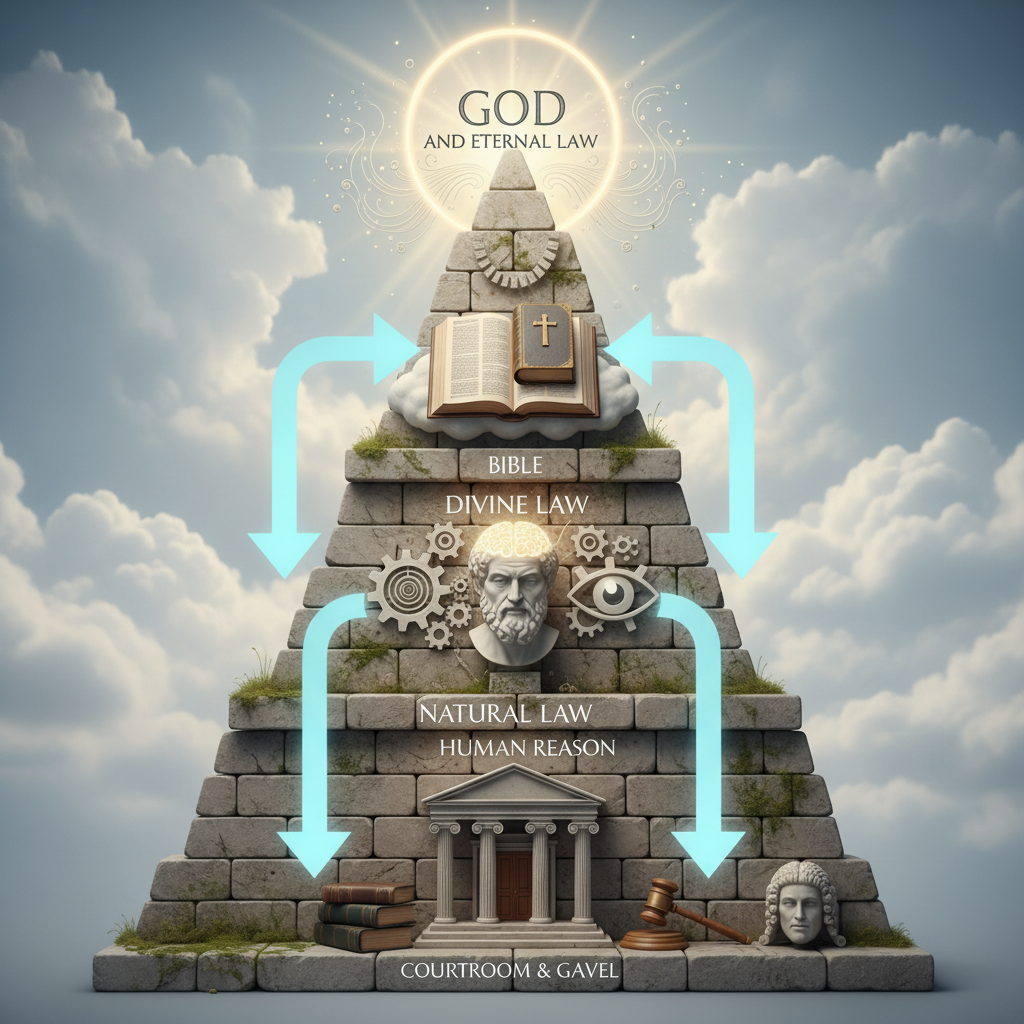
Summary
Aquinas says God's moral order is structured in four "levels" (tiers) of law: Eternal Law – God'sperfect, eternal plan in His mind for how all reality should be ordered. Divine Law – What God has revealed in Scripture (e.g. Bible) to guide us to heaven. Natural Law – The part of eternal law built into human nature and knowable by reason (e.g. "do good and avoid evil," "preserve life," "live in society"). Human Law – Specific laws made by governments and societies (e.g. traffic laws, criminal law) that should be based on Natural Law. Good human laws flow from Natural Law, which itself is a share in Eternal Law; Divine Law fills in what Natural Law cannot show (especially about salvation and grace).
Detailed Explanation
Aquinas' four tiers of law explain how God's moral order "comes down" to humans.
Tier 1: Eternal Law
What It Is:
- God's rational plan for the whole universe—known perfectly only by God.
- It is God's wisdom ordering all things to their proper ends (telos).
Key Features:
- Universal and absolute—unchanging and applies to everyone, everywhere, all of the time
- Exists in God's mind from eternity
- We cannot see eternal law directly, but we "participate" in it when we act rationally in line with our nature
Analogy:
Think of an architect's complete plan for a building—but this is God's plan for all of reality.
Tier 2: Divine Law
What It Is:
The part of God's eternal law that is revealed supernaturally in Scripture and Church teaching (e.g., the Bible, Ten Commandments).
Why Needed If We Already Have Natural Law?:
- We are ordered to a supernatural end (heaven, Beatific Vision) which reason alone can't fully know
- Human reason is weakened by sin, so we need clearer guidance
- Some things are too hard for everyone to work out by reason (e.g., detailed teaching about grace, sacraments, salvation)
- Divine Law provides certainty where human reason might err
Examples:
• The Ten Commandments (Decalogue)
• Jesus' teachings and parables
• Teachings about sacraments and salvation
Tier 3: Natural Law
What It Is:
The part of eternal law that applies to human beings as rational creatures and is knowable by reason.
Aquinas' Classic Definition:
"Natural Law is the rational creature's participation in the eternal law."
Root Principle (Synderesis Rule):
"Good is to be done and pursued, and evil is to be avoided" Or more simply: "Do good and avoid evil".
How It Works:
- Humans have the ability to reason (unlike animals)
- Through reason, we can work out, by observing the world, what actions follow Natural Law
- From natural inclinations, reason identifies primary precepts (fundamental moral rules)
Key Features:
- Objective and universal—applies to all humans because it flows from human nature
- Discoverable by reason—even without reading Scripture
Tier 4: Human Law
What It Is:
Particular laws made by human authorities (parliaments, courts, governments) to apply Natural Law to specific societies and situations.
Examples:
• Speed limits
• Tax law
• Criminal law (e.g., murder, theft)
• Property laws
Good Human Law:
- Derives from Natural Law (e.g., murder is illegal because it violates "preserve life")
- Aims at the common good
- Is within the legitimate authority of the lawmaker
- Applies equally to all
Bad Human Law:
If it contradicts Natural Law, it is not a true law at all in Aquinas' sense.
Aquinas' Famous Principle:
"Lex iniusta non est lex" — "An unjust law is no law at all"
Aquinas' Three Tests for Unjust Law:
A law is unjust if it fails in:
Purpose:
Not for the common good but for the lawmaker's interests
Authority:
Exceeds the legitimate powers of the person making it
Form:
Imposes burdens unequally in the community
How the Four Tiers Fit Together
Top-Down Hierarchy:
ETERNAL LAW (God's overall plan and wisdom)
        ↓
   ┌────┴────┐
   ↓         ↓
DIVINE LAW   NATURAL LAW
(revealed,   (built into human nature,
for salvation) known by reason)
                 ↓
            HUMAN LAW
        (civil and criminal law)
The Relationships:
- When we use reason well → we follow Natural Law (share in Eternal Law)
- When we obey good Human Laws → we concretely live out Natural Law
- When we follow Divine Law (Scripture) → we are guided beyond natural ends to our supernatural telos with God
Scholarly Perspectives
"Now among all others, the rational creature is subject to Divine providence in the most excellent way, insofar as it partakes of a share of providence, by being provident both for itself and for others. Wherefore it has a share of the Eternal Reason, whereby it has a natural inclination to its proper act and end: and this participation of the eternal law in the rational creature is called the natural law."
Context: Aquinas' foundational definition explaining how Natural Law is humanity's rational participation in God's Eternal Law—humans uniquely share in God's providence through reason.
"Lex iniusta non est lex" — "An unjust law is no law at all." Aquinas writes that a law may be unjust in respect of its end (not for the common good), its authority (exceeds legitimate powers), or its form (imposes burdens unequally). Any such unjust law would be invalid, and disobedience might then be not merely a possibility but, if the law offends against natural law, a duty.
Context: Aquinas' influential teaching that human laws must conform to Natural Law to be valid—a law that contradicts Natural Law has no binding moral authority.
Quick Reference: The Four Tiers of Law
| Tier | Definition | Source | Key Feature |
|---|---|---|---|
| Eternal Law | God's rational plan for all creation | God's mind | Known only to God; we participate through reason |
| Divine Law | God's revealed law in Scripture | Bible, Church teaching | Guides to supernatural end; supplements reason |
| Natural Law | Rational creature's participation in eternal law | Human reason | Universal, objective; "do good, avoid evil" |
| Human Law | Specific civil laws made by governments | Human authorities | Must derive from Natural Law; unjust law = no law |
Key Takeaways
- ✓Four tiers: Eternal → Divine → Natural → Human
- ✓Eternal Law: God's perfect, eternal plan for all creation—known only by God
- ✓Divine Law: revealed law in Scripture (Bible)—guides to salvation and supplements reason
- ✓Natural Law: "rational creature's participation in eternal law"—discoverable by reason
- ✓Human Law: specific man-made rules applying Natural Law to particular societies
- ✓Good human law must derive from Natural Law and serve the common good
- ✓"Lex iniusta non est lex"—an unjust law is no law at all
- ✓Aquinas' three tests for unjust law: wrong purpose, wrong authority, unequal form
- ✓All tiers connected: good ethics = acting according to our God-given nature within God's ordered universe