Aquinas' Primary Precepts
Summary
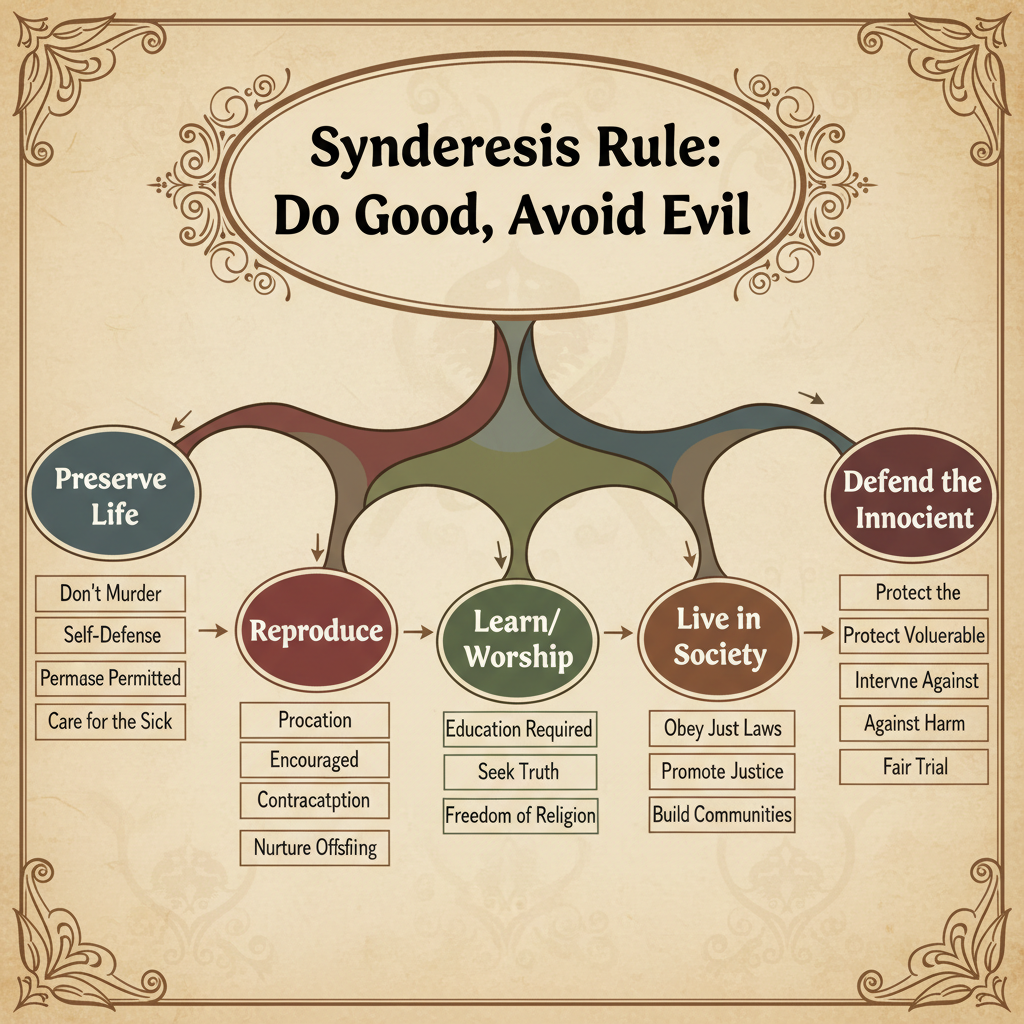
Aquinas identified five primary precepts—fundamental moral principles that flow from human nature and are knowable by reason. These are discovered through observing what humans naturally incline toward (our natural inclinations). The five primary precepts can be remembered as W.O.R.L.D.: (1) Worship God, (2) Ordered society (live in community), (3) Reproduction (continue the species), (4) Learning (seek truth), (5) Defence of life (preserve life). From these primary precepts, humans use reason (conscientia) to generate secondary precepts—specific rules applicable to particular situations (e.g., "don't murder" follows from preserving life). While primary precepts are universal and unchanging, secondary precepts can vary by culture and circumstance. Synderesis is the innate human ability to grasp the foundational principle: "Do good and avoid evil".
Detailed Explanation
The Foundation: Synderesis and the Synderesis Rule
What Is Synderesis?
- Synderesis (Latin from Greek syneidesis, "conscience") is the innate human capacity to grasp the first principles of morality.
- It's a natural habit of reason—a built-in ability we all possess.
The Synderesis Rule
The first principle that synderesis grasps is: "Do good and avoid evil" or "Good is to be pursued, evil is to be avoided".
Aquinas' Quote:
"There belongs to the natural law, first, a certain most general precept, that is known to all: that good must be done and pursued, and evil is to be avoided. And upon this are founded all the other precepts of the natural law."
How It Works
- All humans, regardless of culture or education, naturally understand that they should do good and avoid evil.
- This is not learned—it's inherent to human reason.
- From this foundational principle, all other moral reasoning flows.
The Five Primary Precepts
What Are Primary Precepts?
- Primary precepts are the most fundamental moral principles that flow directly from human nature and natural inclinations.
- They are universal—the same for all humans in all times and cultures.
- They are unchanging—not subject to cultural variation.
- They are self-evident—knowable by reason through observing human nature.
How Are They Derived?
Aquinas observed that humans have natural inclinations (desires, drives) rooted in our nature. Through reason, we recognize these inclinations as goods worth pursuing. The principle: Whatever humans naturally incline toward is a primary precept (a basic good).
The Five Primary Precepts: W.O.R.L.D.
1. Worship God
The Inclination:
- Humans naturally incline toward seeking the ultimate source of reality and truth.
- We recognize that we are created beings dependent on something greater.
The Primary Precept:
"Worship God" — to recognize, honor, and serve God as our creator and ultimate end.
Secondary Precepts from This:
- Pray regularly
- Attend religious services
- Show reverence for sacred things
2. Ordered Society (Live in Community)
The Inclination:
- Humans naturally incline toward living in community with others.
- We are social animals who need others to survive and flourish.
The Primary Precept:
"Live in ordered society" — to participate in communities with justice and fairness.
Secondary Precepts from This:
- Obey just laws
- Don't steal (respects others' property rights)
- Don't lie or deceive
- Treat others fairly
- Avoid offending neighbors
Historical Example:
Aquinas noted that the ancient Germans didn't consider theft morally wrong, even though it violates this precept. This shows that awareness of secondary precepts can be obscured by cultural error, even though the primary precept itself is universal.
3. Reproduction (Continue the Species)
The Inclination:
- Humans naturally incline toward sexual reproduction and family life.
- We have a biological and social drive to produce offspring.
The Primary Precept:
"Reproduction" — to have children and continue God's creation.
Secondary Precepts from This:
- Sexual intercourse is only within marriage
- Contraception is morally wrong (prevents reproduction)
- Procuring abortion is wrong
- Care for children is a moral duty
Note:
Modern natural law theorists like Finnis have modified this precept to "marital good" allowing that sexual relations serve other goods beyond procreation (e.g., spousal union and intimacy).
4. Learning (Seek Truth)
The Inclination:
- Humans naturally incline toward understanding, knowledge, and truth.
- We want to know how the world works and our place in it.
The Primary Precept:
"Education/Learning" — to pursue knowledge and teach others.
Secondary Precepts from This:
- Pursue education
- Don't spread ignorance or misinformation
- Support schools and universities
- Teach children
5. Defence of Life (Preserve Life)
The Inclination:
- Humans naturally incline toward self-preservation and the preservation of others.
- We naturally want to live and to protect others from harm.
The Primary Precept:
"Preserve life" — to protect and defend human life.
Secondary Precepts from This:
- Don't murder
- Don't commit suicide
- Provide food, shelter, medical care
- Don't torture
- Act in self-defence
Complex Application — Self-Defence:
Even though murder is wrong, Aquinas permits killing in self-defence. Why? Because your intention is to preserve your own life, and killing the attacker is a secondary effect (foreseen but not intended). This introduces the Doctrine of Double Effect, which we'll explore later.
Secondary Precepts and Conscientia
What Are Secondary Precepts?
Secondary precepts are specific moral rules derived from the primary precepts through reason and applicable to particular situations and cultures. They are detailed, practical conclusions from the first principles.
Conscientia (Applied Reason)
Conscientia is the human faculty of practical reason that applies the primary precepts to specific moral situations. It is the judgment we make in particular cases.
Key Distinction
- Primary precepts = universal and unchanging
- Secondary precepts = variable and context-dependent
Examples of Variation
Different cultures can have different secondary precepts that still serve the same primary precept:
- Driving on the left (UK) vs. right (US) — both serve the primary precept of ordered society
- Arranged marriage traditions vs. individual choice — both serve the primary precept of reproduction
- Different punishment systems (prison, rehabilitation, etc.) — all serve ordered society and justice
Why We Sometimes Get Secondary Precepts Wrong
Even though primary precepts are self-evident to reason, we frequently make errors in conscientia (errors in applying them).
Aquinas Acknowledges Multiple Causes:
- Original sin: Our reason is weakened by sin
- Cultural corruption: We're influenced by unjust customs and laws
- Moral vice: Lack of virtue obscures our judgment
- Passion and desire: Our appetites can override reason
- Ignorance: We may simply not know better
Historical Examples:
Ancient Germans didn't consider theft wrong, even though it violates the precept "live in ordered society"
Some cultures have practiced slavery, obscuring the precept "treat all as bearers of dignity"
Medieval practices tolerated torture, obscuring the precept "preserve life"
Strengths of Aquinas' Primary Precepts
Strength 1: Grounded in Observable Human Nature
Aquinas' theory is based on empirical observation of what humans naturally desire. We can observe that humans want to survive, reproduce, learn, live in society, and worship. These are not arbitrary impositions but reflect our actual nature.
Strength 2: Universal and Objective
Because based on human nature (shared by all), the primary precepts are universal. They apply to all people, everywhere, always. Morality is objective—not relative to culture or opinion.
Strength 3: Provides Coherence and Organization
The five primary precepts give a systematic organization to moral reasoning. Any moral rule can be traced back to one of the five precepts. This provides a coherent framework for making moral decisions.
Strength 4: Balances Universality with Cultural Flexibility
While primary precepts are unchanging, secondary precepts can vary by culture. This explains moral universals across cultures (everyone values life, family, community). It also explains moral variation (different ways of implementing these values).
Criticisms of Aquinas' Primary Precepts
Criticism 1: Contentious List
Different scholars have proposed different lists of primary precepts.
Examples:
- Grisez adds: self-integration, authenticity, playfulness, appreciation of beauty
- Finnis adds: knowledge, play, aesthetic experience
- Modern theorists: add things like friendship, health, practical reasonableness
The Problem: If Aquinas' list was supposed to be self-evident and universal, why do later thinkers disagree? This suggests his list might be culturally conditioned rather than objectively derived.
Criticism 2: Naturalistic Fallacy
Aquinas moves from what is natural (humans desire reproduction) to what is morally required (reproduce). But just because something is natural doesn't mean it's morally good.
Example:
Violence might be "natural" (humans have aggressive impulses), but that doesn't make it morally good.
Response (Aquinas):
For Aquinas, human nature is God-designed and therefore reflects moral purposes. What's natural to human flourishing just is what's morally good.
Criticism 3: Oversimplification
The five precepts are too broad to generate specific moral rules. How do "preserve life" and "ordered society" apply to issues like:
- Euthanasia of the terminally ill
- Pulling the plug on comatose patients
- Capital punishment
- Artificial reproduction and surrogacy
The Problem: Reason can derive opposite conclusions from the same precept depending on how you frame the situation. This makes the theory less helpful for moral guidance.
Criticism 4: Misses Sexual Ethics Issues
Aquinas' precepts reduce reproduction to biological procreation. They ignore the relational, spousal, and pleasure dimensions of sexuality. Modern natural law theorists like Finnis have improved on this with the notion of "marital good".
Criticism 5: Underestimates Human Reason's Capacity
If these precepts are truly self-evident, why do we need priests, theologians, and moral teachers? In practice, conscientious moral reasoning requires education, reflection, and guidance—not just observing nature.
Scholarly Perspectives
"Since, therefore, good has the nature of an end, and evil, the nature of a contrary, hence it is that all those things to which man has a natural inclination, are naturally apprehended by reason as being good, and consequently as objects of pursuit, and their contraries as evil, and objects of avoidance. Wherefore according to the order of natural inclinations, is the order of the precepts of the natural law."
Context: Aquinas' explanation of how primary precepts are derived from natural human inclinations—whatever humans naturally desire is recognized by reason as good and becomes a moral precept.
"There belongs to the natural law, first, certain most general precepts, that are known to all; and secondly, certain secondary and more detailed precepts, which are, as it were, conclusions following closely from first principles... The first precept of law is that 'good is to be done and pursued, and evil is to be avoided.' All other precepts of the natural law are based upon this."
Context: Aquinas distinguishes universal primary precepts from variable secondary precepts, showing how the synderesis rule ("do good, avoid evil") is the foundation from which all other moral reasoning flows.
Quick Reference: Aquinas' Primary Precepts
| Precept | Natural Inclination | Goal | Secondary Precepts |
|---|---|---|---|
| Worship God | Seek ultimate truth/source | Honor God | Pray, attend services, show reverence |
| Ordered Society | Live in community | Justice and fairness | Obey just laws, don't steal, don't lie |
| Reproduction | Sexual/family drive | Continue creation | Sex within marriage, contraception concerns |
| Learning | Seek knowledge | Understanding | Support education, teach others |
| Preserve Life | Self-preservation | Survival and flourishing | Don't murder, don't suicide, act in self-defence |
Key Takeaways
- ✓Synderesis: innate human ability to grasp 'Do good, avoid evil'
- ✓Primary precepts: five universal, unchanging principles from human nature
- ✓W.O.R.L.D.: Worship, Ordered society, Reproduction, Learning, Defence of life
- ✓Derived from natural inclinations: what humans naturally desire is what's morally good
- ✓Secondary precepts: specific rules applied through conscientia (practical reason)
- ✓Primary precepts universal; secondary precepts vary by culture and circumstance
- ✓Examples: 'preserve life' → 'don't murder'; 'ordered society' → 'don't steal'
- ✓Conscientia can err due to sin, culture, passion, ignorance
- ✓Self-defence permitted by Doctrine of Double Effect (good intention, secondary evil effect)
- ✓Strength: grounded in observable human nature; universal and objective
- ✓Criticism 1: Different lists proposed by different theorists
- ✓Criticism 2: Naturalistic fallacy—just because natural doesn't mean morally good