Secondary Precepts
Summary
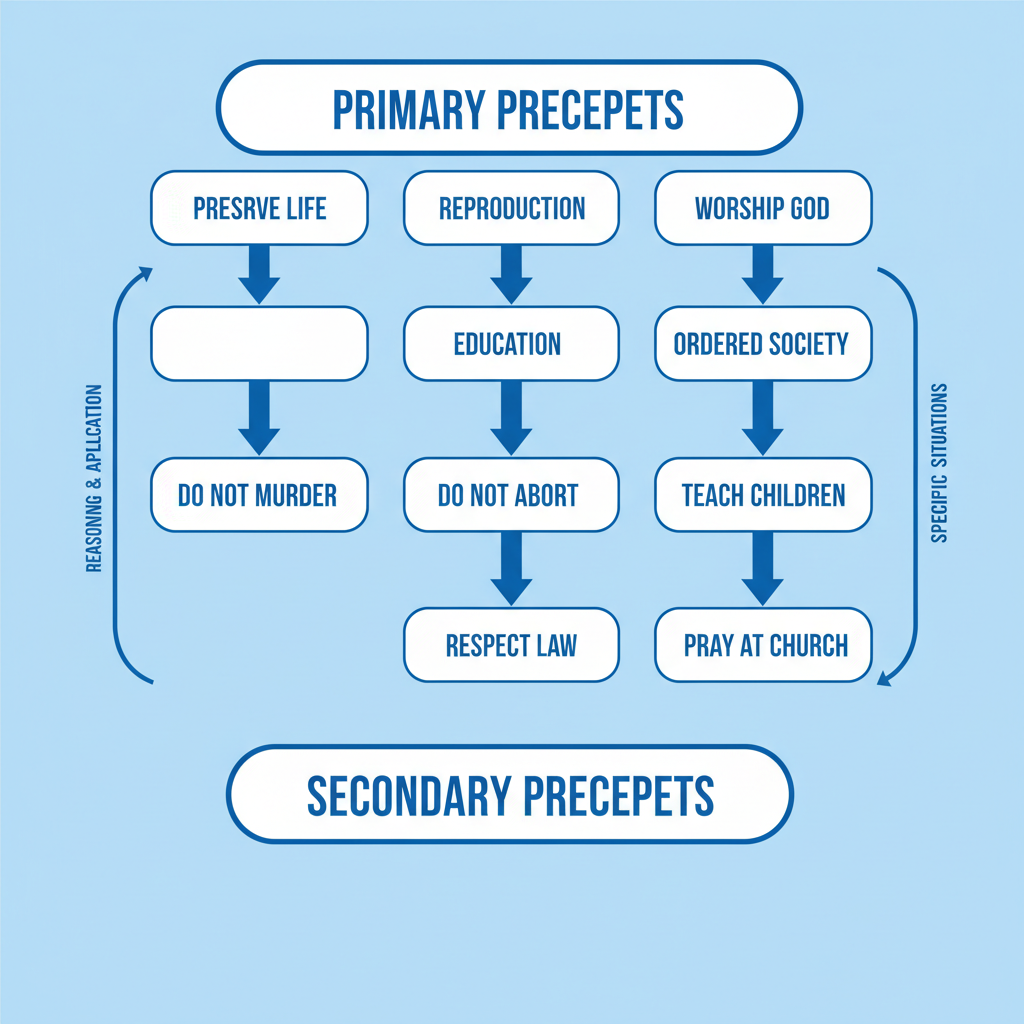
Primary precepts are very general principles built into human nature (like "preserve life," "reproduce," "seek knowledge," "live in society," "worship God"). But they"re too abstract to guide everyday moral decisions. So humans use their reason to apply these general principles to specific situations—this is how we derive secondary precepts. Secondary precepts are concrete moral rules like "do not murder," "do not abort," "respect the law," and "tell the truth". They"re called "secondary" because they come second— derived from primary precepts. Conscientia is the ability to reason through situations and create or recognise appropriate secondary precepts. Unlike primary precepts (which are universal and unchanging), secondary precepts can vary between cultures depending on circumstances, yet all must uphold the underlying primary precepts.
Detailed Explanation
The Problem with Primary Precepts Alone
They"re Too Abstract
The primary precepts are very broad and general. "Preserve life" doesn"t tell us whether we should:
- Eat animals or be vegetarian?
- Allow capital punishment?
- Permit surgery (which might harm)?
- Allow abortion in certain circumstances?
They Don"t Provide Practical Guidance
Aquinas recognised that we need to apply these general principles to specific moral situations. This is where secondary precepts come in.
What Are Secondary Precepts?
Definition
Secondary precepts are specific moral rules derived from primary precepts through the application of reason to particular situations. They are conclusions that follow from the primary precepts.
Examples of Secondary Precepts
| Primary Precept | Secondary Precepts (Examples) |
|---|---|
| Preserve life | Do not murder; Do not commit suicide; Provide medical care; Do not abuse |
| Reproduce | Do not abort; Do not use contraception; Do not commit adultery; Marry and have children |
| Seek knowledge | Pursue education; Tell the truth; Do not lie or deceive |
| Live in society | Respect the rule of law; Do not steal; Do not lie; Be honest in business |
| Worship God | Pray regularly; Attend church; Show reverence; Appreciate beauty |
Real vs. Apparent Goods
Real Goods
Real goods are secondary precepts that genuinely accord with Natural Law. They truly fulfill the primary precepts. Example: "Do not murder" really does protect the primary precept of preserving life.
Apparent Goods
Apparent goods are secondary precepts that seem right but actually violate Natural Law. They fail to fulfill the primary precepts or even contradict them.
Aquinas" Example:
A law saying "Women cannot drive" is presented as a secondary precept. But it actually violates the primary precept of living in an ordered society. It"s an apparent good, not a real good.
Conscientia: Reasoning to Discover Secondary Precepts
What Is Conscientia?
Conscientia is the human ability of conscience or practical reason to apply primary precepts to specific situations. It is not mere emotion or feeling—it"s the use of reason to judge what"s right. Through conscientia, we discover which secondary precepts should guide our actions.
How Conscientia Works
Step 1: Recognise the Primary Precept
Identify which primary precept is relevant. Example: Euthanasia involves the primary precept of"preserve life".
Step 2: Apply Reason to the Situation
Use rational judgment to think through how the primary precept applies here. Consider: Does euthanasia preserve or end life? Does it respect human dignity?
Step 3: Derive a Secondary Precept
Conclude a specific moral rule for this situation. Example: "Euthanasia is morally wrong because it violates the primary precept of preserving life".
Conscientia Can Be Wrong
Conscientia uses reason, but human reason is fallible. We can make mistakes in applying primary precepts to situations. Example: We might think "Treat Christians as secondary citizens" is a good secondary precept. But through dialogue with Christians in society, we realize this violates Natural Law. The remedy is that we must talk and interact with others in society. Community discussion helps us discover real goods and correct apparent goods.
Universality vs. Variability
Primary Precepts: Universal and Unchanging
Primary precepts are absolutely universal—they apply to all people in all times. They cannot change. Everyone must preserve life, reproduce, seek knowledge, live in society, and worship God.
Secondary Precepts: Variable but Grounded
Secondary precepts are NOT all universal—they can vary between cultures and situations. But they are not arbitrary—they must all derive from and respect the primary precepts.
Example: Speed limits
The primary precept is "live in ordered society". Societies can create different secondary precepts about driving: Drive on the right in the USA; Drive on the left in the UK. Both secondary precepts serve the same primary precept—just implemented differently.
Example: Marriage and family
The primary precept is "reproduce and educate offspring". Different cultures have different secondary precepts about marriage age, number of partners, and divorce arrangements. As long as they preserve and educate children, different secondary precepts are valid.
Example: Worship practices
The primary precept is "worship God". Different religions have different secondary precepts about when to pray, what rituals to perform, and how to show reverence. All are valid secondary precepts deriving from the same primary precept.
The Constraint: All Must Reflect Primary Precepts
While secondary precepts can vary, they must ALL uphold the primary precepts. If a secondary precept contradicts a primary precept, it is immoral and should be rejected.
The Doctrine of Double Effect
Why It"s Needed
Sometimes moral actions have two effects—one good and one bad. If we only follow secondary precepts rigidly, we might condemn necessary moral actions.
Example: Emergency Surgery
A surgeon performing emergency surgery to save a mother"s life. The two effects: Good effect - Saving the mother"s life (fulfills "preserve life"); Bad effect - The surgery causes pain or harm (seems to violate "preserve life"). Is the surgery morally wrong because of its bad effect? Aquinas says no, if conditions are met.
Four Conditions for Double Effect
For an action with both good and bad effects to be morally justified:
1. The Intentionality Condition
The good effect must be intended; the bad effect must be unintended (or "beside the intention"). The agent must genuinely aim at the good effect. The bad effect is accepted as a side effect, not chosen for itself. Example: The surgeon intends to save the mother, not to cause pain.
2. The Proportionality Condition
The good effect must be equal to or greater than the bad effect. You can"t use massive harm to achieve minor good. The proportion of benefit must justify the harm. Example: Saving a mother"s life is proportional to the pain and potential harm of surgery.
3. The Means-End Condition
The bad effect and good effect must both be brought about immediately—at the same time. The bad effect cannot be used as a means to the good effect. Example: The pain is a side effect of the surgery, not a means to healing.
4. The Serious Reason Condition
There must be a serious reason to permit the bad effect. Trivial goods don"t justify significant harms. Example: Saving a life is a serious reason; learning a skill is not.
Scholarly Perspectives
"There belong to the natural law, first, certain most general precepts, that are known to all; and secondly, certain secondary and more detailed precepts, which are, as it were, conclusions following closely from first principles. Thus to order oneself to the good is a first precept of natural law. All the other precepts of natural law are based upon this, so that whatever is a means of preserving human life, and of warding off its obstacles, belongs to the natural law."
— Thomas Aquinas, Summa Theologica (I-II, Q. 94, Art. 2)
Aquinas explains how primary precepts are general principles, while secondary precepts are specific applications derived through reason—the latter are "conclusions" from the former.
"When humans are faced with a moral choice, they must use reasoning to work out whether or not their action will uphold the primary precept. In doing this, they create a secondary precept. This is an application of the Natural Law to a specific situation. The secondary precepts vary depending on the situation, but they will always uphold the primary precepts. An unjust secondary precept—one that contradicts a primary precept—should not be followed."
— A-Level religious studies summary of Aquinas" natural law
Practical application of conscientia—reasoning through particular moral situations to discover concrete secondary precepts that accord with primary precepts.
Key Takeaways
- ✓Primary precepts: universal, unchanging principles (preserve life, reproduce, seek knowledge, live in society, worship God)
- ✓Secondary precepts: specific moral rules derived from primary precepts
- ✓Examples: "do not murder" from "preserve life"; "tell the truth" from "live in society"
- ✓Conscientia: practical reason used to apply primary precepts to specific situations
- ✓Real goods: secondary precepts that truly accord with Natural Law
- ✓Apparent goods: secondary precepts that seem right but violate Natural Law
- ✓Secondary precepts CAN vary between cultures; primary precepts CANNOT
- ✓All secondary precepts must uphold primary precepts; if not, they're immoral
- ✓Doctrine of Double Effect: actions with good and bad effects can be justified if conditions are met
- ✓Four conditions: intentionality, proportionality, means-end, serious reason
- ✓Even Aquinas recognizes secondary precepts can have exceptions in extreme circumstances