Freud's Psychological Approach to Conscience
Summary
Freud's psychological approach explains conscience as the superego—the internalized voice of parents and society living in our unconscious mind. The superego develops around ages 3-6 through the Oedipus Complex, when children identify with their same-sex parent and internalize their rules and moral codes.
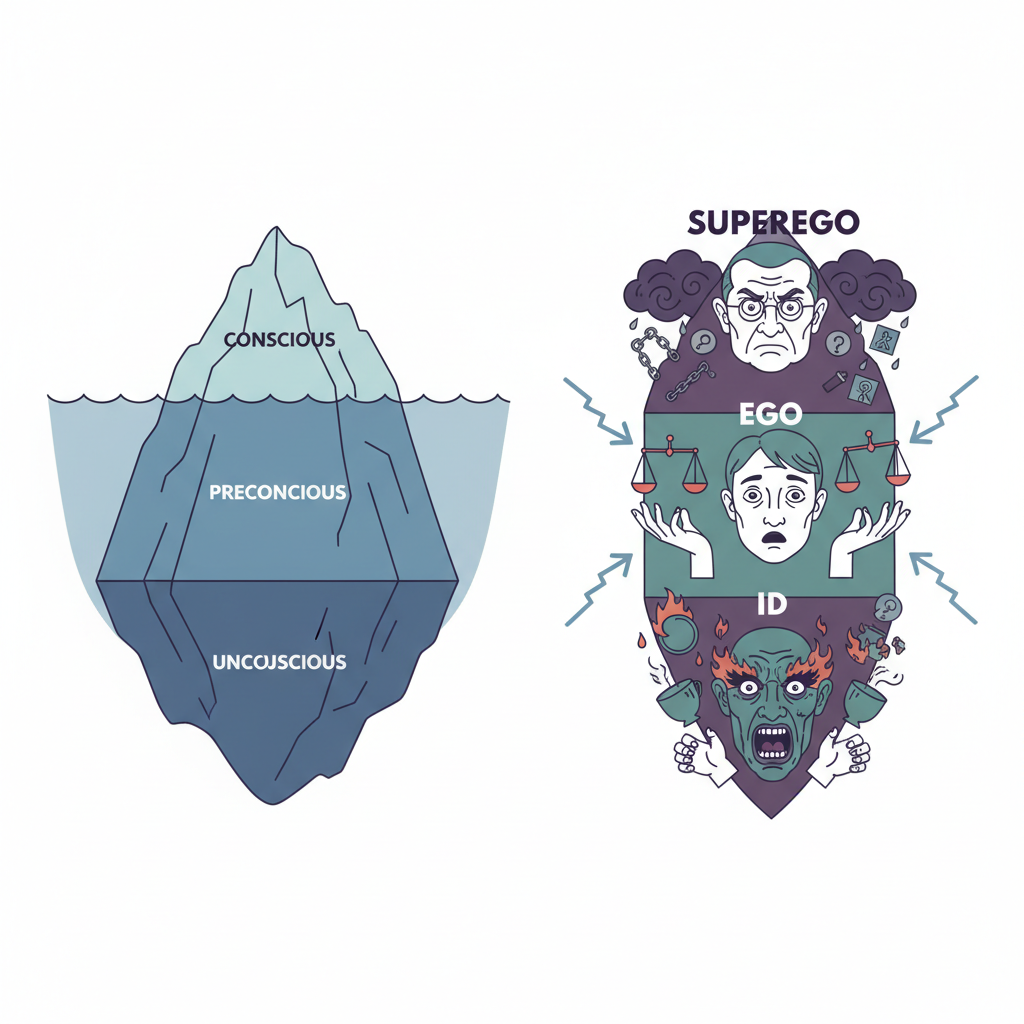
Conscience is not divine (as Aquinas said) but psychological: it's a learned system of guilt and shame imposed by parents. The Id (primal desires) constantly pushes for gratification, the Superego (internalized rules) condemns those desires, and the Ego (rational self) mediates between them. When we act against the superego's rules, we feel guilty—not because we've violated God's law, but because we fear parental disapproval internalized in our psyche.
Detailed Explanation
What is Freud's Psychological Approach?
Definition
Freud explains conscience as a psychological mechanism, not a spiritual or rational one. Conscience is the superego—an internalized system of parental and social rules that operates largely in the unconscious mind.
The Three Parts of the Psyche
1. The Id (The Instinctive Child)
- Operates on the pleasure principle—seeks immediate gratification
- Wants food, sleep, sexual satisfaction, aggression without limitation
- Entirely non-moral—has no sense of right or wrong
- Operates in the unconscious mind
2. The Ego (The Rational Mediator)
- Operates on the reality principle—balances the Id's desires with reality
- Develops around ages 1-3 as the child learns reality constraints
- Rational and conscious, but also uses defence mechanisms (repression, denial, projection) to manage unconscious conflicts
- Must mediate between the Id ("I want!") and the Superego ("You must not!")
3. The Superego (The Internalized Moral Parent)
- Develops around ages 3-6 during the phallic stage of development
- Operates on the morality principle—judges actions as right or wrong
- Represents internalized parental rules and social norms
- Operates largely in the unconscious but also the preconscious (accessible but not currently in awareness)
How the Superego Forms: The Oedipus Complex
The Critical Moment
Around ages 3-6, the child enters the phallic stage and develops the Oedipus Complex:
- For boys: The boy desires his mother (sexually, though unconsciously) and sees his father as a rival
- For girls: The girl desires her father and sees her mother as a rival (the Electra Complex)
The Source of Anxiety
- The boy fears his father will castrate him (castration anxiety) as punishment for his desires
- This intolerable fear forces the boy to give up his desire for his mother
The Resolution Through Identification
To resolve the conflict and reduce anxiety, the boy identifies with his father. By becoming like the father, the boy:
- Gains a share of the father's power and authority
- Internalizes the father's rules, values, and moral codes
- Transforms his rivalry with the father into a psychological structure (the superego)
The Birth of the Superego
- The external conflict with the father becomes an internal moral voice
- The superego is essentially the internalized father or parental authority watching and judging the ego's actions
The Two Parts of the Superego
1. The Conscience
- The part that punishes through guilt and shame
- Says "You should not do that" and makes you feel guilty when you do it
- Based on internalized prohibitions ("Thou shalt not...")
2. The Ego Ideal
- The part that rewards through pride and self-esteem
- Represents aspirations and ideals—how you should be
- Makes you feel pride when you live up to these standards
How Conscience Works (Guilt Mechanism)
Step 1: The Id Desires
An impulse arises (aggression, sexuality, selfishness).
Step 2: The Superego Objects
The internalized parental voice says "That's wrong!"
Step 3: Anxiety and Guilt
The conflict between Id and Superego creates anxiety and guilt. The ego uses defence mechanisms to manage this conflict.
Step 4: Behavior Adjustment
To reduce guilt and anxiety, the person obeys the superego (acts morally).
Unconscious Guilt
The Deeper Level
- Freud proposed that unconscious guilt is a fundamental part of human psychology
- This guilt exists even before the Oedipus Complex
- It's a deeper, underlying feeling that drives behavior without conscious awareness
- The superego is one manifestation of this underlying unconscious guilt
Problems: The Overly Harsh Superego
Overly Strong Superego
If the superego is too strong or punitive, it can cause:
- Excessive guilt and shame, even for minor actions or mere thoughts
- Anxiety and depression
- Obsessive neurosis with compulsive, repetitive behaviors
- Self-punishment and self-harm
Overly Weak Superego
If the superego is too weak, it can cause:
- Lack of guilt for wrongdoing (sociopathic behavior)
- Antisocial behavior without remorse
Strengths of Freud's Approach
Explains Guilt and Shame
- Accounts for why we feel guilty even when no one knows about our actions
- Guilt is the internalized fear of parental punishment
Explains Moral Development
- Shows how children acquire moral standards through identification with parents
- Explains why moral standards are often irrational (we obey rules without understanding why)
Explains the Power of the Unconscious
- Recognizes that much of moral behavior is driven by unconscious processes, not conscious reasoning
- Explains why we sometimes act against our conscious beliefs
Practical Clinical Application
- Helps psychotherapists understand and treat guilt, shame, and neurosis
Weaknesses of Freud's Approach
Not Grounded in Reason
- Conscience becomes arbitrary—based on what your particular parents taught, not on universal moral principles
- Makes conscience culturally and individually relative, not objective
Ignores Divine or Natural Law
- Rejects the idea that conscience might reflect God's law or human nature's purpose
- Offers no account of why conscience often points toward universal moral truths (e.g., that murder is wrong)
Overemphasis on Childhood and Sex
- The Oedipus Complex is controversial and not universally accepted
- Not clear that the superego develops primarily from the Oedipus Complex
Difficult to Verify
- The unconscious mind is hard to observe and test scientifically
- Psychoanalytic claims are difficult to falsify
Explains Away Morality
- Reduces moral truth to psychological mechanisms, which many find unsatisfying
- Seems to suggest that moral convictions are just internalized parental voice, not real moral knowledge
Scholarly Perspectives
"The superego is the ethical component of personality. It contains internalised ideals from parents and society, and it opposes the id's desires. The superego develops around ages 3-6 and causes us to feel guilt when we transgress. Conscience is essentially the superego, the internalized voice of parental authority judging our actions."
Freud's foundational statement of how conscience develops psychologically through internalization of parental authority.
"The superego is the psychological presence of the parental authority, always observing and judging the actions and intentions of the ego. It is this internal regulator that compels the adult to adhere to social rules, feel remorse for misdeeds, and strive for perfection."
This captures how the superego functions as an internalized parent guiding moral behavior through guilt and shame.
Key Takeaways
Superego = Conscience
Freud replaces the idea of God-given conscience with a psychological superego—the internalized voice of parental and social authority.
Three Parts of Psyche
Id (primal desires), Ego (rational mediator), and Superego (internalized morality) constantly interact to shape behavior.
Oedipus Complex
Ages 3-6: child identifies with same-sex parent and internalizes their rules through resolution of the Oedipus Complex and castration anxiety.
Two Parts of Superego
Conscience (punishes with guilt and shame) and Ego Ideal (rewards with pride when living up to internalized standards).
Guilt = Internalized Fear
We feel guilty because the superego is the internalized voice of the feared/respected parent, not because we've violated objective moral law.
Mostly Unconscious
Conscience operates in the unconscious, not through conscious reasoning like Aquinas suggested—moral behavior is driven by unconscious processes.
Problems with Harsh Superego
Too much guilt leads to neurosis, anxiety, and depression; too little leads to antisocial behavior without remorse.
Relative, Not Universal
Unlike Aquinas's objective synderesis, Freud's superego depends on your particular upbringing—making conscience culturally and individually relative.
Quick Reference Table
| Aspect | Aquinas (Theological) | Freud (Psychological) |
|---|---|---|
| Source of Conscience | Divine—God gives reason/synderesis | Psychological—internalized parental authority |
| Is Conscience Rational? | Yes—conscience applies reason to God's law | No—conscience is mostly unconscious, non-rational |
| How Does It Develop? | Innate synderesis + education/experience | Through Oedipus Complex (ages 3-6) via identification with same-sex parent |
| Role of Parents | Parents educate conscience through teaching | Parents imprint moral rules directly into unconscious via fear/castration anxiety |
| Is Conscience Infallible? | Synderesis is infallible; conscientia is fallible | Superego can be harsh, weak, or distorted by upbringing |
| Guilt | Result of violating synderesis/God's law | Result of Id-Superego conflict; fear of parental punishment internalized |
| Universal or Relative? | Universal—all humans have the same primary precepts | Relative—depends on what parents taught you |
| Can Conscience Be Wrong? | Yes, if conscientia makes mistakes | Yes, if superego is harshly punitive or weak |