Globalisation
Summary
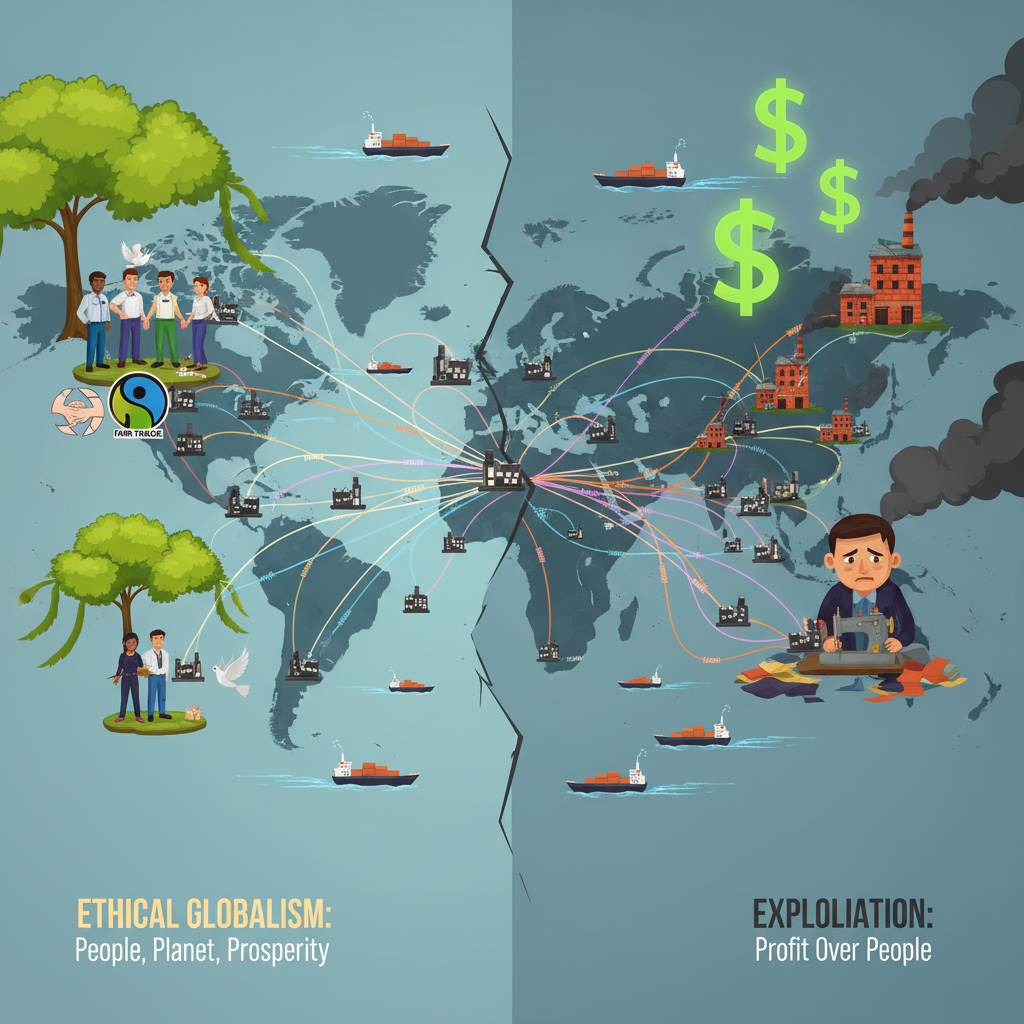
Globalisation in business ethics is about how companies now operate all over the world, and how that creates new moral problems as well as new opportunities. Globalisation means the integration of economies, laws and companies across the world: production in one country, headquarters in another, customers everywhere. Big firms like Apple, Nike, McDonald's and Amazon design in rich countries but manufacture in poorer ones, where labour and regulation are cheaper. This raises key ethical questions: Are sweatshops and off-shore factories simply providing jobs, or exploiting workers with low pay and poor conditions? Are global firms lifting people out of poverty, or destroying local cultures and the environment? Utilitarians might justify globalisation if it maximises overall happiness (cheaper goods, more jobs), while Kantians criticise it when it uses workers merely as a means to profit, for example in sweatshops.
Detailed Explanation
What Is Globalisation?
Definition
Globalisation is the process by which economies, industries, markets, cultures, and laws of different countries become interconnected and interdependent.
For Business Ethics, This Means:
- Multinational corporations (MNCs) operate across many countries.
- Production, supply chains, and labour can be moved to wherever is cheapest or most efficient.
- Decisions made in one boardroom can impact workers, communities, and environments on the other side of the world.
Key Features of Globalisation in Business
1. Off-shore Outsourcing and Sweatshops
Companies close factories in richer countries and open them in poorer ones where labour is cheaper.
Positive:
Jobs and investment in developing countries; cheaper products for consumers.
Negative:
Low wages, long hours, unsafe conditions, child labour (sweatshops).
2. Race to the Bottom
To attract investment, poorer countries may weaken labour or environmental laws, leading to:
- Unsafe factories
- Environmental damage (pollution, deforestation)
- Weak enforcement of human rights
3. Cultural Globalisation
Global brands (McDonald's, Starbucks, Netflix) spread a homogeneous global culture, sometimes:
Positive:
Breaking down barriers; easier communication; shared experiences.
Negative:
Erosion of local traditions, languages, and small local businesses.
4. Global Supply Chains
A single product (like a smartphone or t-shirt) may involve:
- Cotton grown in one country
- Fabric produced in another
- Assembled in a third
- Sold in dozens of others
This makes it harder to track who is responsible for exploitation or damage.
Ethical Issues Raised by Globalisation
1. Sweatshops: Exploitation or Opportunity?
Sweatshops:
Factories with low pay, long hours, poor safety, sometimes child labour.
Utilitarian Defence:
- Workers choose these jobs because they are better than the alternatives (e.g. subsistence farming).
- Sweatshops can be a stepping stone to development, as happened historically in South Korea and Taiwan.
- If they raise overall utility (more jobs, cheaper goods), utilitarians might justify them.
Kantian Critique:
- Using workers in unsafe sweatshops treats them merely as a means to profit, not as ends in themselves.
- Violates human dignity and workers' rights, even if it brings some benefits.
Christian / Natural Law Critique:
- Violates the duty to protect the vulnerable and respect human dignity.
- Fails the idea of being good stewards of creation and caring for the poor.
2. Environmental Damage
Globalisation often leads to:
- Higher CO₂ emissions from global shipping and aviation
- Deforestation and pollution from resource extraction in poorer countries
Ethically:
- Utilitarians balance economic benefits against long-term environmental harm.
- Kantians stress duties to future generations and not using nature in a purely instrumental way.
- Christian ethics emphasise stewardship and caring for creation.
3. Power and Inequality
Globalisation often shifts power from:
- Local communities and governments
- To multinational corporations and global markets
Ethical concerns:
- Local people may have no voice in decisions that affect their land and livelihoods.
- Neocolonialism: Economically powerful countries and companies dominate weaker nations, echoing old colonial patterns.
Ethical Theories Applied to Globalisation
Utilitarianism
Potential Support:
- Cheaper goods benefit millions of consumers.
- Jobs in developing countries can lift people out of extreme poverty.
Potential Criticism:
- If exploitation causes huge amounts of hidden suffering, then the net happiness might be negative.
- Utilitarians may underestimate long-term harms (climate change, cultural loss, inequality).
Kantian Ethics
Concerns:
- Sweatshops and exploitative practices often use workers merely as means for profit, violating Kant's second formulation.
- False advertising and opaque supply chains violate the duty of honesty and transparency.
- Kantians might support globalisation only if it respects rights, autonomy, and fair treatment for all involved.
Scholarly Perspectives
A-level Summary
"Globalisation integrates world economies, laws and companies. This gives multinational corporations enormous power to move production to where labour is cheapest and laws are weakest. The result is that what is good for a business—cheap production and high profits—is not always good ethics, particularly when it comes to sweatshops, environmental damage and the erosion of local cultures."
This captures the tension between economic benefits and ethical costs arising from globalisation.
Academic Discussion
"Globalisation has fundamentally reshaped the landscape of business ethics. It has expanded the scope of corporate responsibility, demanding greater transparency, accountability and sensitivity to cultural diversity. Businesses can no longer afford to operate with narrow or outdated ethical frameworks. Instead, they must adopt inclusive, globally relevant standards that promote fairness, sustainability and the social wellbeing of people."
This quote emphasises that globalisation forces companies to rethink ethics at a global scale, not just a local or national one.
Key Takeaways
Globalisation = Interconnected World
Goods, people, money, and data move easily across borders, integrating economies and cultures.
Creates Jobs and Growth, But Also Exploitation
Investment in developing countries can lift people out of poverty, but sweatshops and environmental harm are major concerns.
Utilitarian Perspective
Might defend sweatshops if they raise total happiness, but risk underestimating hidden suffering and long-term harms.
Kantian Critique
Criticise globalisation when it treats people as tools, not as ends in themselves, violating human dignity and rights.
Global Ethics Required
Companies are expected to uphold decent labour, environmental and human rights standards wherever they operate.
Quick Reference: Pros and Cons of Globalisation
| Potential Ethical Benefits | Potential Ethical Harms |
|---|---|
| Jobs and investment in developing countries | Sweatshops and worker exploitation |
| Cheaper goods for consumers worldwide | Environmental damage and resource depletion |
| Cultural exchange and global communication | Loss of local cultures and small businesses |
| Pressure on companies to follow global ethical standards (e.g. UN Global Compact, fair trade) | Power imbalance: MNCs can override local communities and governments |