Bentham's Hedonic Calculus
Summary
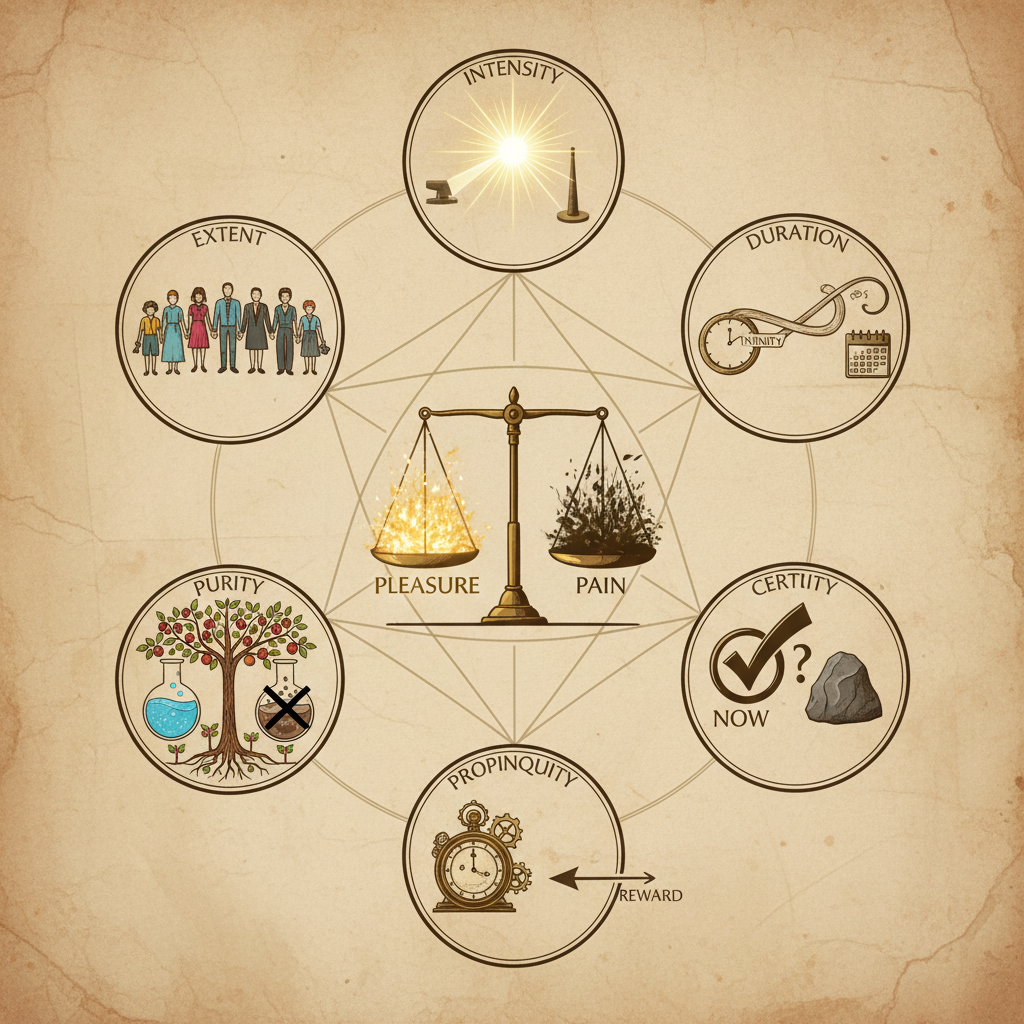
The Hedonic Calculus (also called the Felicific Calculus) is Jeremy Bentham's method for measuring the pleasure and pain produced by an action to determine if it maximizes utility. It consists of seven criteria: Intensity (how strong), Duration (how long), Certainty (how likely), Propinquity or Nearness (how soon), Fecundity (will it lead to more pleasure), Purity (is it unmixed with pain), and Extent (how many people affected). You apply all seven to every person affected, calculate their total utility, add them all together, and the action with the highest total is the right action. Bentham admitted this is often impractical, but it's the ideal guide for moral decision-making. The calculus exemplifiesBentham's quantitative hedonism—all pleasures are equal and can be measured like mathematics.
Detailed Explanation
What is the Hedonic Calculus?
Definition
A systematic method for quantifying (measuring) the pleasure and pain produced by an action so you can determine objectively which action will maximize utility (greatest happiness for greatest number).
Why Bentham Created It
Bentham believed morality is too important to be left to guesswork or feelings. He wanted to make ethics scientific and measurable. The Hedonic Calculus is his attempt to turn morality into a calculation, like mathematics.
The Seven Criteria Explained
1. INTENSITY
What it measures:
How strong is the pleasure or pain?
Why it matters:
A mild pleasure (eating a sweet) is less valuable than an intense pleasure (passionate love). Similarly, severe pain (broken leg) matters more than minor pain (stubbed toe).
Example:
- Pleasure from watching a 2-hour film = moderate intensity
- Pleasure from eating a meal = low intensity
- Pleasure from romance = high intensity
2. DURATION
What it measures:
How long will the pleasure or pain last?
Why it matters:
Pleasure that lasts weeks matters more than pleasure that lasts minutes. Long-lasting pain is worse than brief pain.
Example:
- Eating chocolate = a few minutes of pleasure
- Watching a movie = 2 hours of pleasure
- Recovering from surgery = months of pain
3. CERTAINTY
What it measures:
How sure can we be that this pleasure or pain will actually happen?
Why it matters:
Guaranteed pleasure is better than uncertain pleasure. You should 'discount' uncertain outcomes.
Example:
- Getting cash from an ATM = certain pleasure
- Winning the lottery = uncertain pleasure (low probability)
- Therefore, the ATM outcome ranks higher
4. PROPINQUITY (Nearness/Remoteness)
What it measures:
How soon will the pleasure or pain occur?
Why it matters:
Immediate pleasure is more valuable than distant pleasure. We naturally discount future rewards.
Example:
- A bonus paid next week = highly proximate pleasure
- A possible promotion next year = distant pleasure
- Therefore, the bonus scores higher
5. FECUNDITY
What it measures:
Will this pleasure lead to further pleasures (or this pain lead to more pains)?
Why it matters:
An action that spawns additional pleasure is better than an action producing only isolated pleasure. Similarly, pain that generates more pain is especially bad.
Example:
- Joining a hobby club = immediate pleasure + meeting friends (additional pleasure)
- Smoking = brief pleasure + addiction to more smoking (fecund pain)
- Exercising = some immediate pain + better health + more energy (fecund pleasure)
6. PURITY
What it measures:
Is the pleasure free from pain, or is it mixed?
Why it matters:
'Pure' pleasure (uncontaminated by pain) is better than 'mixed' pleasure (some pain attached). 'Pure' pain is when pain isn't followed by pleasure.
Example:
- Eating dessert = relatively pure pleasure (little pain attached)
- Vigorous exercise = mixed pleasure/pain (effort hurts, but success feels good)
- Having a tooth extracted = relatively pure pain (dentist removes pain, but at cost of immediate suffering)
7. EXTENT
What it measures:
How many people will be affected by this pleasure or pain?
Why it matters:
Pleasure affecting many people is better than pleasure affecting few. Pain affecting many people is especially bad.
Bentham's Democratic Principle:
'Each to count for one, and no one for more than one.' A king's happiness counts the same as a pauper's.
Example:
- A policy helping 1 million people > a policy helping 100 people
- Therefore, policies with larger extent score higher
Bentham's Own Mnemonic
Bentham created a poem to remember the seven factors (though it's hard to remember!):
IDCPRFE or the easier modern acronym: PRRICED
- Purity
- Remoteness (Propinquity)
- Richness (Fecundity)
- Intensity
- Certainty
- Extent
- Duration
How to Use the Hedonic Calculus
Step-by-step process:
1. Identify all people affected by the action
2. For each person, evaluate all seven criteria
3. Calculate a score for each person (combining the 7 criteria)
4. Add all scores together to get total utility for that action
5. Compare alternative actions using the same method
6. Choose the action with the highest total utility
Strengths and Weaknesses
Strengths
Objective Framework
Provides a systematic method to evaluate actions, not just gut feelings.
Democratic
Everyone counts equally; no person's pleasure is worth more than another's.
Practical Approximation
Even if we can't calculate perfectly, it's a useful guide.
Weaknesses (Criticisms)
Impossible to Measure
Pleasure is subjective. How do you compare the intensity of my pleasure to your pleasure?
Prediction Problem
We often can't know future consequences. Fecundity requires predicting years ahead.
Quantifies the Unquantifiable
Some things (love, dignity, rights) aren't reducible to pleasure/pain numbers.
Can Justify Terrible Things
If rape's victim's pain can be outweighed by multiple rapists' pleasure, the calculus produces immoral results.
Too Time-Consuming
Who has time to calculate seven factors for every decision?
Scholarly Perspectives
Jeremy Bentham
"It is the greatest happiness of the greatest number that is the measure of right and wrong... To calculate, therefore, the utility of any action, you must calculate the pleasures and pains it will produce on each person affected by it, using the seven criteria of intensity, duration, certainty, propinquity, fecundity, purity, and extent."
This establishes both the principle of utility and the method (Hedonic Calculus) for calculating which actions best serve it. It shows Bentham's attempt to make morality scientific and measurable.
Jeremy Bentham
"Quantity of pleasure being equal, push-pin is as good as poetry... The more pleasure the merrier. It does not matter whether it comes from high art or simple games, what counts is the amount of pleasure produced."
Bentham's radical claim of quantitative hedonism—all pleasures are on the same scale and can be compared numerically. It illustrates his purely quantitative approach to utility, contrasting withMill's later qualitative hedonism.
Key Takeaways
Seven Criteria: PRRICED
Purity, Remoteness (Propinquity), Richness (Fecundity), Intensity, Certainty, Extent, Duration— remember this mnemonic for the seven factors.
Bentham's Assumption
All pleasures are quantifiable and comparable, like money. This is quantitative hedonism.
Democratic Principle
"Each to count for one, and no one for more than one"—everyone's happiness counts equally.
Practical vs. Ideal
Bentham admitted it's often impractical but should be "kept in view" as a guide for moral reasoning.
Interpersonal Comparison Problem
This is the biggest challenge—comparing your hedons (units of pleasure) to my hedons. Pleasure is subjective and difficult to measure objectively.
Quick Reference: The Seven Criteria
| Criterion | Question to Ask | Example |
|---|---|---|
| Intensity (I) | How strong is it? | Broken leg pain > stubbed toe pain |
| Duration (D) | How long does it last? | 2-hour film > 5-minute snack |
| Certainty (C) | How sure will it happen? | ATM cash > lottery win |
| Propinquity (P) | How soon will it occur? | Bonus next week > raise next year |
| Fecundity (F) | Will it create more pleasure? | Exercise → fitness → health |
| Purity (Pu) | Is it unmixed with pain? | Dessert is purer than exercise |
| Extent (E) | How many people affected? | Help 1 million > help 100 |