Application of Natural Law & Situation Ethics to Euthanasia
Summary
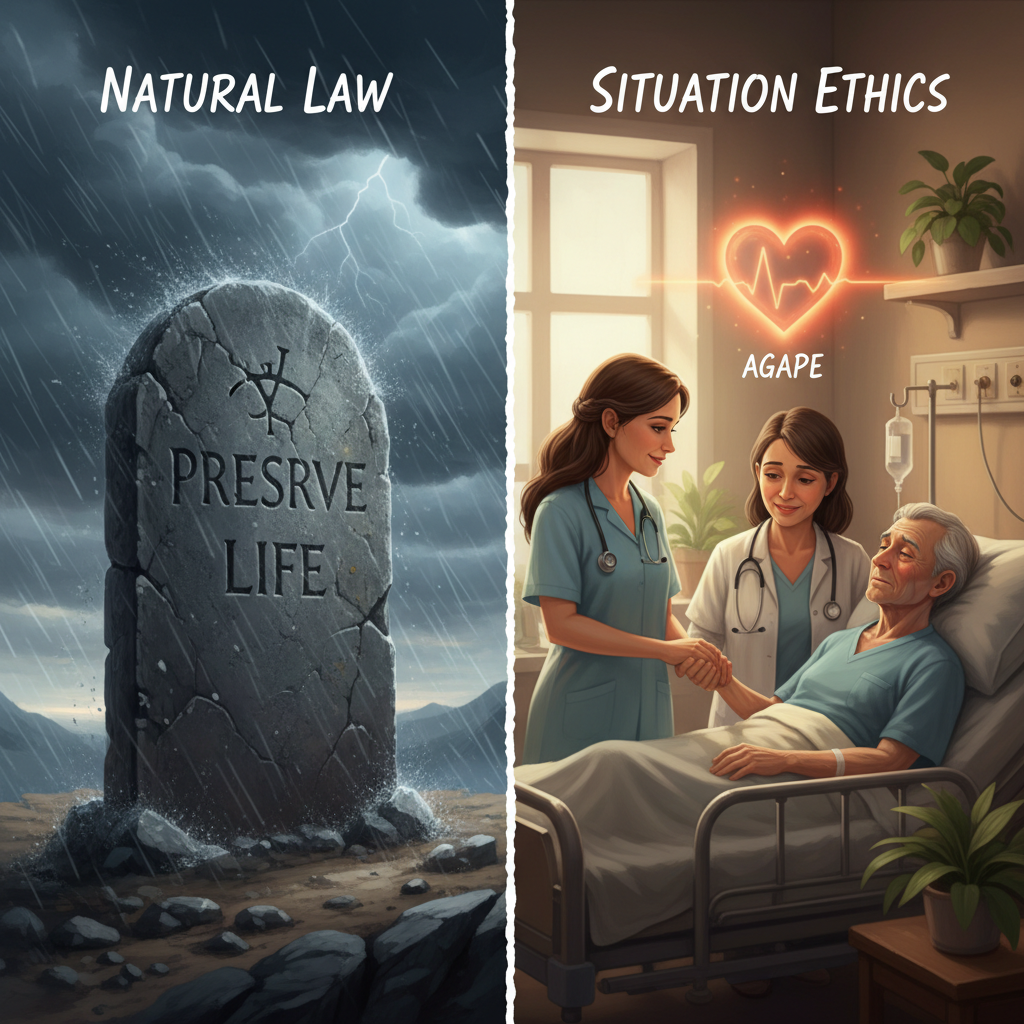
Natural Law (Aquinas) is strongly against euthanasia. It views euthanasia as a violation of the primary precepts (especially "Preserve Life") and argues that life is a gift from God that we have no right to destroy. It rejects active euthanasia as murder, though it allows double effect (giving painkillers that shorten life as a side effect). Situation Ethics (Fletcher) is generally for euthanasia. It argues there are no absolute rules; the only rule is to do the most loving thing (Agape). If keeping someone alive causes useless suffering, love demands we help them die. Fletcher argues that being a person depends on intelligence and relationships, not just biology, so ending a life without these qualities can be the loving choice.
Detailed Explanation
Natural Law: The Absolutist "NO"
Core Argument
Natural Law is deontological and absolutist. Actions are right or wrong based on whether they fulfill human nature (telos), not consequences.
Applying the Primary Precepts
Preserve Life
This is the most important precept. Euthanasia directly violates the natural drive to survive. Suicide is "contrary to the inclination of nature".
Worship God
Life is God's property ("The Lord gave and the Lord has taken away"). Euthanasia plays God, rejecting His sovereignty.
Ordered Society
Allowing killing might lead to a slippery slope where vulnerable people feel pressured to die, disrupting social order.
The Doctrine of Double Effect
Active Euthanasia
(Intentionally killing) is always wrong.
Palliative Care
(Giving morphine to stop pain) is permissible, even if it foresees (but does not intend) shortening life. The intention is to stop pain, not to kill.
Key Distinction
Natural Law distinguishes between ordinary means (food, water, basic care—must always be given) and extraordinary means (complex, burdensome life support—can be withdrawn). Stopping extraordinary treatment is not "killing"; it is accepting death.
Situation Ethics: The Relativist "YES" (Usually)
Core Argument
Situation Ethics is teleological and relativist. There are no fixed rules ("Thou shalt not kill" is just a guideline/Sophia). The only absolute is Agape (unconditional Christian love).
Applying the Four Working Principles
Pragmatism
What works? Keeping a terminally ill patient in agony serves no purpose. Euthanasia works to end suffering.
Relativism
There is no "never". In this specific situation of agony, killing is right, even if it's usually wrong.
Positivism
We choose to value Love above Law. The law says "preserve life," but love says "end pain".
Personalism
People come first, not rules. The patient's dignity is more important than the abstract rule "Preserve Life".
Fletcher's View
"It is harder to justify letting someone die a slow and ugly death, dehumanised, than it is to justify helping them escape from such misery."
Life is not valuable just because it is biological (Sanctity of Life). It is valuable only if it has personhood (intelligence, relationships). If these are gone, euthanasia acts lovingly.
The Conflict: Sanctity vs. Quality of Life
Natural Law (Sanctity of Life)
- Life has intrinsic value because God made it.
- Suffering can have redemptive meaning (uniting with Christ's suffering).
- Killing is always wrong, even to end suffering.
Situation Ethics (Quality of Life)
- Life has instrumental value only if it allows for meaningful experience.
- Pointless suffering has no value.
- Killing is sometimes right if it is the most loving thing to do.
Doctrine of Double Effect Explained
The Four Conditions
1. The Act Itself Must Be Good or Neutral
Giving painkillers is good/neutral.
2. The Good Effect Must Be Intended
The doctor intends to stop pain.
3. The Bad Effect Must Not Be the Means
Death is not the means to stop pain; pain relief is the means.
4. Proportionality
The good effect (ending unbearable pain) outweighs the bad effect (shortening life by days/weeks).
Example
A doctor gives a terminally ill patient high-dose morphine to relieve pain, knowing it might hasten death by a few days. This is permissible under Natural Law because the intention is to relieve pain, not to kill.
Criticism
Situation Ethics would say: "Why does intention matter? The patient dies either way. If death is a good outcome (ends suffering), then intending it is loving."
Ordinary vs. Extraordinary Means
Natural Law Distinction
Ordinary Means
Food, water, basic nursing care. These must always be provided because withdrawing them is killing.
Extraordinary Means
Life support, ventilators, experimental treatments. These can be withdrawn if they are burdensome or offer no hope.
Example
A PVS patient on a ventilator: Natural Law says withdrawing the ventilator (extraordinary means) is permissible. But withdrawing a feeding tube (ordinary means) is not.
Criticism
Critics say this distinction is arbitrary. A feeding tube is just as much "life support" as a ventilator. Situation Ethics rejects the distinction entirely—if withdrawing treatment is the most loving thing, then do it.
Scholarly Perspectives
St. Thomas Aquinas (Natural Law)
"Suicide is contrary to the inclination of nature, and to charity whereby every man should love himself. Life is God's gift to man, and is subject to His power, who kills and makes to live. Hence whoever takes his own life, sins against God."
Aquinas gives three reasons why suicide (and thus voluntary euthanasia) is wrong: it violates the natural instinct to survive, it harms the community, and it steals from God. This provides the foundational Natural Law argument against all forms of euthanasia.
Joseph Fletcher (Situation Ethics)
"To prolong life uselessly, while the personal qualities of freedom, knowledge, self-possession and control, and responsibility are sacrificed is to attack the moral status of a person."
Fletcher argues that keeping a body alive when "personhood" is gone is actually immoral. True respect for a person means respecting their right to escape degradation. This directly challenges the Natural Law position that all human life is sacred.
Key Takeaways
Perfect Clash
This topic is the perfect clash between Sanctity of Life (Natural Law) and Quality of Life (Situation Ethics).
Aquinas: Preserve Life
Euthanasia breaks the rule "Preserve Life." It is unnatural and plays God.
Fletcher: Love Thy Neighbour
Euthanasia follows the rule "Love thy neighbour." It is practical and compassionate.
Double Effect Loophole
Remember this for Natural Law—it's the only "loophole" allowing strong drugs that might hasten death, provided the aim is pain relief.
Personhood vs. Human Life
Fletcher thinks being "human" isn't enough; you need to be a "person" (rational/aware). Natural Law disagrees—all human life is sacred.
Absolute vs. Relative
Natural Law is absolutist (euthanasia is always wrong), while Situation Ethics is relativist (it depends on the situation).
Quick Reference: Comparison Table
| Feature | Natural Law (Aquinas) | Situation Ethics (Fletcher) |
|---|---|---|
| View on Euthanasia | Wrong (violates primary precepts) | Right (if it is the most loving thing) |
| Core Principle | Preserve Life (Absolutist) | Agape Love (Relativist) |
| Life's Value | Intrinsic (Sacred/Sanctity of Life) | Instrumental (Quality of Life/Personhood) |
| Suffering | Can have redemptive value; must not kill to end it | Useless; love demands we end it |
| Legalism? | Yes – follows strict moral laws | No – rejects legalism for flexibility |
| Double Effect? | Yes – permits pain relief that shortens life | Irrelevant – intention to kill out of love is fine |