Voluntary Euthanasia: Autonomous Choice
Summary
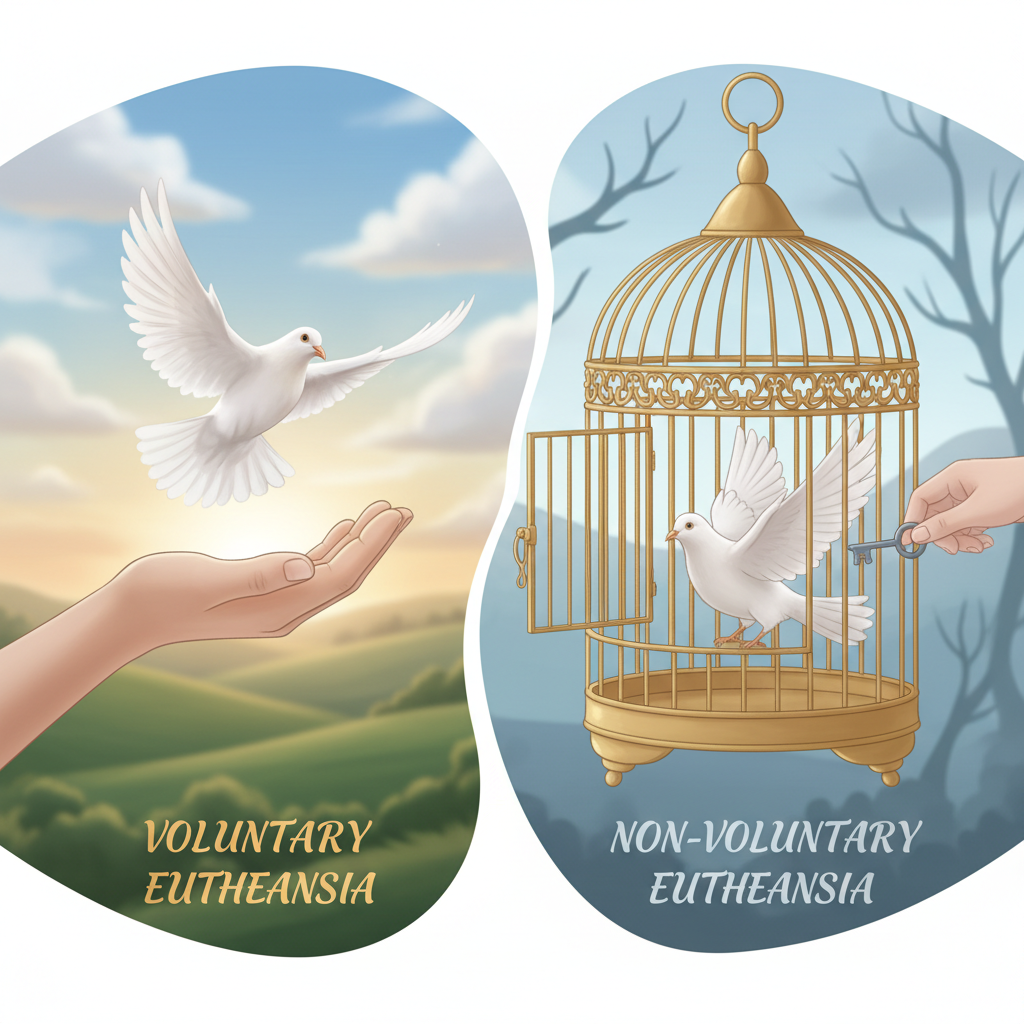
Voluntary Euthanasia is when a person actively requests to have their life ended to stop their suffering, usually because they are terminally ill or in unbearable pain. The key factor is consent: the person is conscious, mentally competent, and asks for help to die. This is different from non-voluntary euthanasia (where the person is in a coma and can't choose) and involuntary euthanasia (killing against a person's wishes, which is murder). Proponents like Peter Singer and John Stuart Mill argue for it based on Autonomy (the right to choose) and Quality of Life (ending suffering). Opponents, particularly religious groups (Sanctity of Life) and Natural Law theorists, argue it is essentially suicide/murder and violates God's will. A major concern is the "Slippery Slope" argument: legalizing voluntary euthanasia might pressure vulnerable people to die.
Detailed Explanation
What is Voluntary Euthanasia?
Definition
The termination of a person's life at their own request and with their full informed consent.
Key Requirements
Competency
The person must be of sound mind and able to make rational decisions.
Voluntariness
The request must be free from pressure (from family, doctors, or society).
Active Assistance
It usually involves a third party (doctor) administering a lethal drug (Active Euthanasia), though it can also involve withdrawing treatment (Passive Euthanasia).
Arguments IN FAVOUR (Autonomy & Compassion)
Autonomy (J.S. Mill's Liberty Principle)
"Over himself, over his own body and mind, the individual is sovereign."
If a competent adult wants to die and it harms no one else, the state has no right to stop them. It is the ultimate expression of personal freedom.
Compassion / Quality of Life
Forcing someone to live in agony is cruel. Euthanasia is an act of mercy (beneficence).
Peter Singer (Preference Utilitarianism): We should respect the preferences of the individual. If they prefer death to suffering, killing them is the ethical choice.
Jonathan Glover's Argument
Being alive is not valuable in itself (intrinsic); it is valuable for consciousness and experiences (instrumental). If a person judges their life has no value left, voluntary euthanasia is justified.
Arguments AGAINST (Sanctity & Slippery Slope)
Sanctity of Life (Religious)
- Life is a gift from God. Only God has the authority to give and take life.
- Suicide (and assisting it) is a rejection of God's sovereignty. "Thou shalt not kill".
Natural Law (Aquinas)
- The primary precept "Preserve Life" is absolute. Euthanasia violates the natural drive to survive.
- It disrupts society's respect for life.
The Slippery Slope (Wedge Argument)
If we allow voluntary euthanasia, we cross a moral line.
- We risk sliding into non-voluntary (killing coma patients) or involuntary (killing the burdensome/elderly) euthanasia because the value of life becomes relative/conditional.
- Example often cited: The Netherlands or Belgium, where laws have arguably expanded over time.
Vulnerable People
Elderly or disabled people might feel pressured ("Right to die becomes duty to die") to stop being a burden on their families.
Voluntary vs. Non-Voluntary vs. Involuntary
It is crucial to distinguish these three for your exam:
Voluntary
"I want to die." (Patient asks for it).
Non-Voluntary
"I can't say." (Patient is in a coma/PVS/infant; decision made by others in their 'best interest').
Involuntary
"I want to live." (Patient wants to live but is killed anyway—this is simply murder).
Scholarly Perspectives
John Stuart Mill
"Over himself, over his own body and mind, the individual is sovereign."
This is the foundational quote for the Autonomy argument. Mill argues that the only reason power can be exercised over a member of a civilized community against his will is to prevent harm to others. Since voluntary euthanasia (arguably) only harms the self, society should not forbid it.
Medical Ethics Debates
"To save a life is not the first and only duty of a doctor... beneficence requires that we act in the patient's best interest, and sometimes death is in the patient's best interest."
This counters the Hippocratic Oath ("Do no harm"). It argues that keeping someone alive in torture is doing harm (maleficence), while ending their suffering is doing good (beneficence).
Key Takeaways
Consent is King
For voluntary euthanasia, the most important factor is that the patient asked for it.
Mill vs. Aquinas
This topic is often a battle between J.S. Mill (Autonomy/Liberty) and Aquinas (Sanctity/Natural Law).
Right to Die?
Does the "Right to Life" imply a "Right to Die"? Autonomy advocates say yes; religious ethicists say no.
Legal Status UK
It is currently illegal in the UK (classified as murder or manslaughter). Assisted suicide is also illegal (Suicide Act 1961).
Slippery Slope Warning
Legalizing voluntary euthanasia might lead to non-voluntary or involuntary euthanasia (Netherlands/Belgium example).
Vulnerable Pressure
Elderly/disabled might feel pressured to die to stop being a burden—"right to die becomes duty to die".
Quick Reference: Key Concepts
| Term | Definition |
|---|---|
| Voluntary Euthanasia | Ending life at the patient's explicit request. |
| Autonomy | Self-rule; the right to make decisions about one's own life. |
| Palliative Care | Specialized medical care for people with serious illness (hospice); often the alternative to euthanasia. |
| Active Euthanasia | DOING something to kill (e.g., injection). |
| Passive Euthanasia | STOPPING something that keeps them alive (e.g., turning off ventilator). |
| Dignitas | Swiss clinic where assisted dying is legal; often cited in case studies. |