Gaunilo's Criticism
Summary
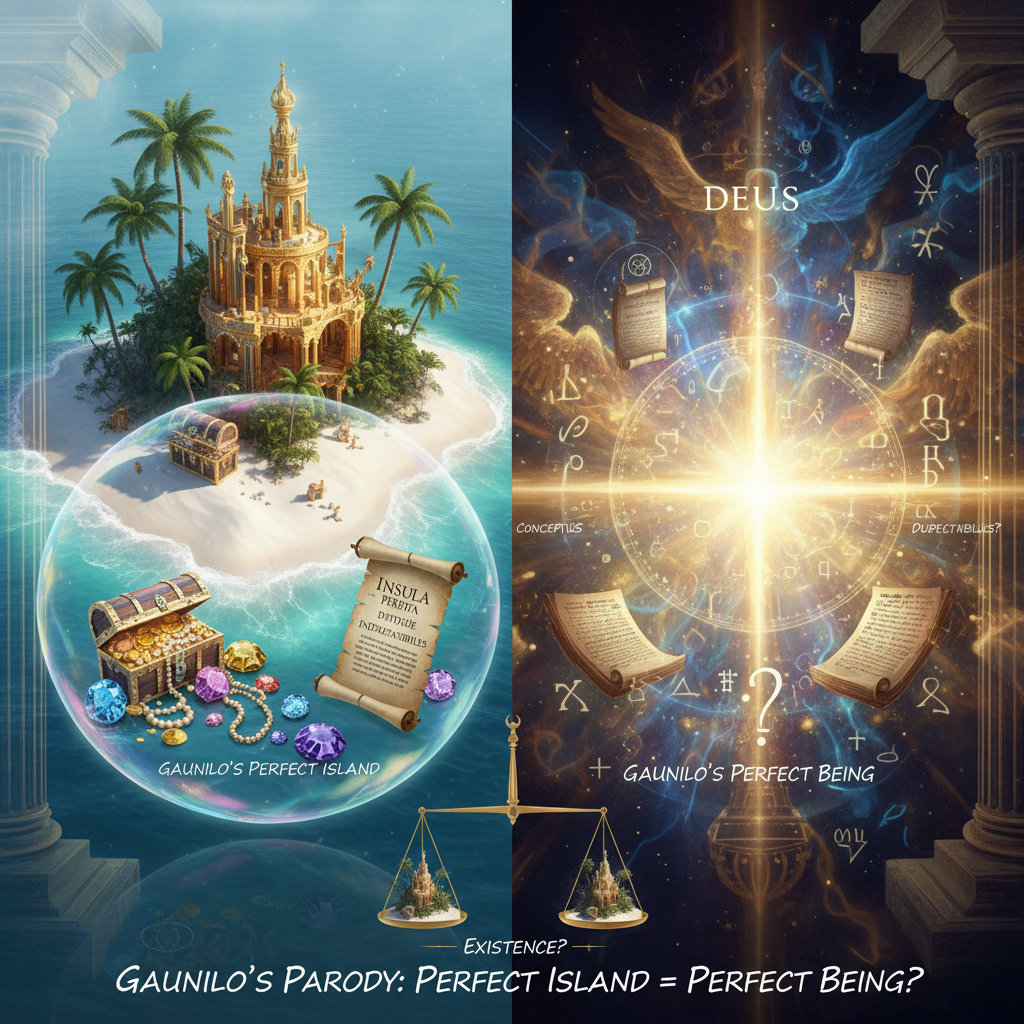
Gaunilo was a monk and contemporary of Anselm who offered a devastating criticism through a parody argument: if Anselm's logic works, then the same reasoning would prove the existence of a perfect Lost Island. You can conceive of an island with all perfect qualities (unlimited riches, perfect climate, no suffering). If this island existed only in your mind and not in reality, couldn't you conceive of something greater—the same island but actually existing? By Anselm's logic, the perfect island must therefore exist. But obviously, the perfect island doesn't exist, so something is wrong with Anselm's reasoning. Gaunilo shows that you cannot define things into existence just by conceiving of them.
Detailed Explanation
Who Was Gaunilo?
- Gaunilo of Marmoutiers was a contemporary of Anselm—they lived at the same time
- Gaunilo was a monk at the monastery of Marmoutiers in France
- Very little is known about Gaunilo beyond his response to Anselm's Proslogion
- He wrote his criticism in a work titled "In Behalf of the Fool" or "What Someone on Behalf of the Fool Replies to These Arguments"
- The title itself is clever—it plays on Anselm's description of atheists as "fools." Gaunilo pretends to defend the fool (the atheist/skeptic) against Anselm's argument
The Logical Application:
Now apply Anselm's reasoning to this island:
P1: The Lost Island is defined as "an island than which no greater island can be conceived"
P2: Everyone understands this concept
P3: Whatever is understood exists in the mind
P4: If the Lost Island existed only in the mind but not in reality, then we could conceive of something greater—the same island but actually existing in reality
P5: But by definition, nothing greater than the Lost Island can be conceived
C: Therefore, the Lost Island must exist in reality
The Structure of Gaunilo's Reductio ad Absurdum
Gaunilo uses the same reductio ad absurdum structure that Anselm used, but turns it against Anselm:
- Reductio ad absurdum means: to refute an argument by showing that following its logic leads to an absurd (clearly false) conclusion
- Anselm's reductio: If God doesn't exist in reality, we could conceive something greater (absurd!) → therefore God exists
- Gaunilo's reductio: If Anselm's logic is valid, then the Lost Island must exist (absurd!) → therefore Anselm's logic is invalid
The Point of the Parody:
Gaunilo's argument has the exact same logical structure as Anselm's:
| Element | Anselm's Argument | Gaunilo's Parody |
|---|---|---|
| Definition | That than which nothing greater can be conceived | An island than which no greater island can be conceived |
| Mental Existence | God exists in the mind | The Lost Island exists in the mind |
| Greatness Principle | Existence in reality is greater | Existence in reality is greater |
| Conceivability | We can conceive it in reality | We can conceive it in reality |
| Conclusion | God exists in reality | The Lost Island exists in reality |
If the logic is sound, both conclusions must follow. But the Lost Island doesn't exist. Therefore, the logic must be unsound.
Gaunilo's Broader Criticisms
1. Concept Does Not Guarantee Existence
Just because you understand a concept doesn't mean something actually exists. Gaunilo argues that he has in his mind "all manner of unreal objects, having absolutely no existence in themselves"—unicorns, fictitious things. The atheist could have the idea of God in his mind without God actually existing in reality. Understanding a concept ≠ the thing's actual existence.
2. From Idea to Reality
Gaunilo suggests you cannot move from the idea of something to its actual existence by logical reasoning alone. You must "step outside" the concept and verify through the senses or empirical evidence. As Kant would later argue: "Whatever, therefore, our concept of an object may contain, we must always step outside it, in order to attribute to it existence."
3. Potential vs. Actual Existence
Following Aristotle's distinction: God might be potentially conceivable, but this doesn't guarantee God is actually existing. The move from potential to actual requires more than just definition.
Gaunilo's Empiricism
Importantly, Gaunilo approaches this issue from an empiricist perspective:
- He believed that the human intellect is only able to comprehend information provided by the senses
- We cannot know about God's existence purely through abstract reasoning—we need evidence from experience
- This is why Gaunilo challenges Anselm's a priori approach (reasoning from definitions alone)
Anselm's Response to Gaunilo
Anselm was remarkably gracious in response to Gaunilo. Rather than being offended, Anselm welcomed Gaunilo's criticism and even suggested it should be published alongside his Proslogion.
1. Gaunilo Didn't Really Understand
Anselm argues that Gaunilo has "definitely missed his point." Anselm claims he was not arguing that any greatest conceivable thing must exist. Rather, Anselm was specifically arguing about "that than which a greater cannot be conceived"—a unique concept.
2. Islands Can Always Be Greater
Unlike God, an island's perfection is always subject to limitations. You can always imagine a greater island—one with more beaches, more treasure, better weather, etc. Islands are contingent things with natural limits and potential flaws. But God is defined as the greatest conceivable being—no greater can be imagined. This makes God's case unique.
3. The Unique Nature of God
Anselm argues that "that than which nothing greater can be conceived" is a unique description that applies only to God. It's not a description that can be applied to arbitrary objects like islands, donuts, or mountains.
Anselm famously states: "Now I promise confidently that if any man shall devise anything existing either in reality or in concept alone (except that than which a greater be conceived) to which he can adapt the sequence of my reasoning, I will discover that thing, and will give him his lost island, not to be lost again."
In other words: Find me ANY other thing to which my argument applies, and I'll grant you that thing exists!
Assessment: Who Won the Debate?
Philosophers disagree on who "won" this early debate:
Those who favor Gaunilo:
- Gaunilo's parody is powerfully intuitive—it seems obviously absurd to prove an island exists through pure logic
- The parody has the same logical structure as Anselm's argument
- If Anselm's structure is valid, it should work for islands too; but it doesn't, so the structure must be flawed
- Just defining something doesn't make it exist
- Concept ≠ reality
Those who favor Anselm:
- "That than which nothing greater can be conceived" is a unique description not applicable to islands
- Islands are contingent and limited; God is necessary and unlimited
- Gaunilo misunderstood the special nature of the God-concept
- You can always imagine a greater island, but not a greater God
- The argument is specifically about necessary existence, not arbitrary perfection
Modern Assessment:
Most modern philosophers think Gaunilo identified a real problem, even if Anselm's response has some merit. The debate shows that the ontological argument is much more subtle than it appears. Simply defining God doesn't obviously guarantee existence. But whether the argument completely fails or merely needs refinement remains contested.
Scholarly Perspectives
"If a man should try to prove to me by such reasoning that this island truly exists, and that its existence should no longer be doubted, either I should believe that he was jesting, or I know not which I ought to regard as the greater fool: myself, supposing that I should allow this proof; or him, if he should suppose that he had established with any certainty the existence of this island."
"Now I promise confidently that if any man shall devise anything existing either in reality or in concept alone (except that than which a greater be conceived) to which he can adapt the sequence of my reasoning, I will discover that thing, and will give him his lost island, not to be lost again."
Key Takeaways
- ✓Gaunilo was a contemporary monk who challenged Anselm almost immediately
- ✓His main objection: the 'Lost Island' parody argument—if Anselm's logic works, it proves the perfect island exists
- ✓The parody has identical logical structure to Anselm's argument
- ✓If the conclusion is absurd (island doesn't exist) but the logic is valid, then something is wrong with the logic
- ✓Gaunilo's key insight: you cannot define things into existence
- ✓Understanding a concept in your mind ≠ the thing actually existing in reality
- ✓Gaunilo appeals to empiricism: knowledge requires sensory evidence, not abstract definitions
- ✓Gaunilo shows the argument could apply to any 'perfect' thing: islands, donuts, mountains
- ✓Anselm's response: 'that than which nothing greater can be conceived' is unique to God
- ✓Anselm argues: islands are contingent and can always be greater; God is necessarily the greatest
- ✓Anselm's challenge: find me any other thing his logic applies to, and I'll concede the point
- ✓Most modern philosophers think Gaunilo identified a real problem, even if Anselm had a point about God being unique