Naturalism
Summary
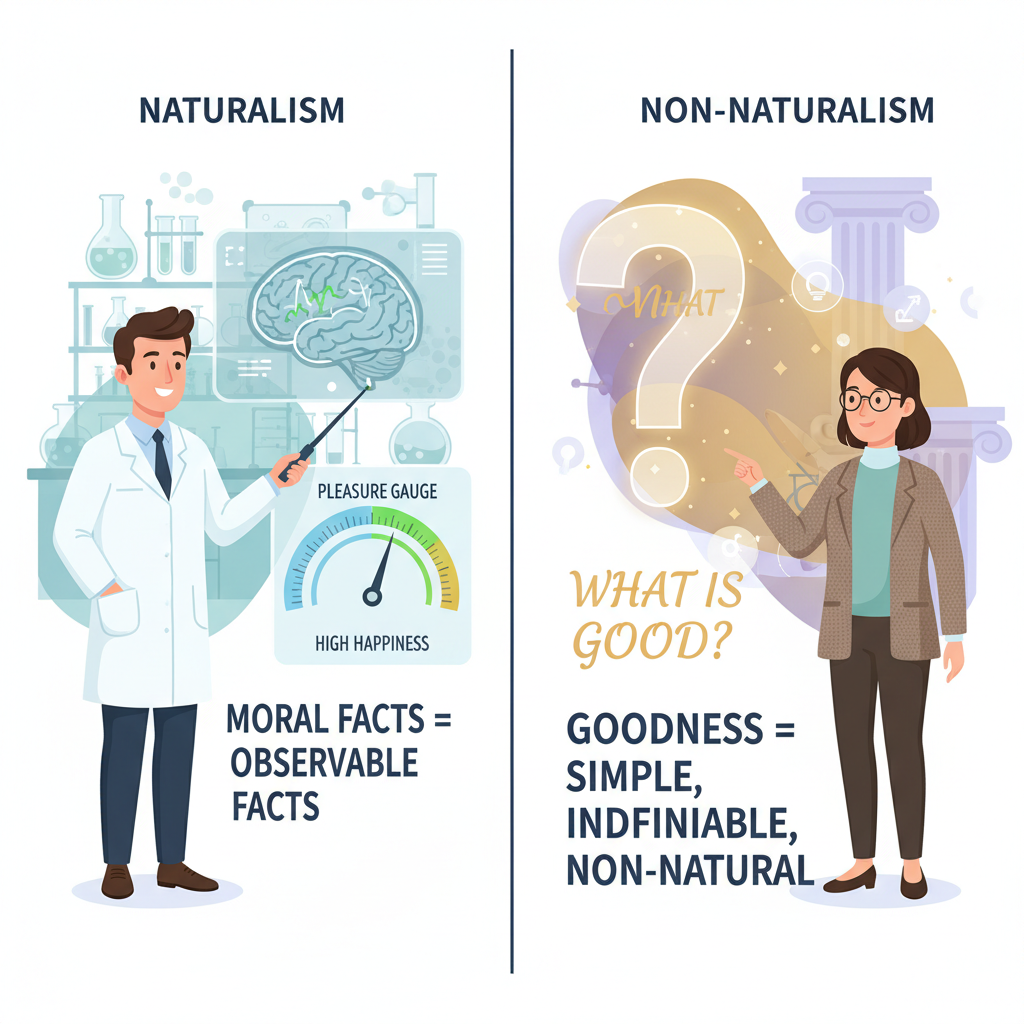
Naturalism is the meta-ethical view that moral terms like "good" and "right" can be defined using natural facts—facts about the physical world that we can observe and measure. For example, Jeremy Bentham (a naturalist) argued that "good" = pleasure and "bad" = pain—both are natural properties of organisms. When we say "Charity is good," we are really saying "Charity produces pleasure/maximises happiness". Naturalism is a form of moral realism—it claims moral facts exist objectively and are discoverable through science or reason. The big problem for naturalism is the is-ought gap (Hume) and G.E. Moore's naturalistic fallacy—both argue you can't define "good" as a natural property without making a logical error.
Detailed Explanation
What is Naturalism?
Definition
Naturalism is the view that moral properties (goodness, rightness) are identical to natural properties (features of the physical world that can be studied by science). Naturalists believe:
- Moral language is cognitive (expresses beliefs that can be true or false).
- Moral facts are objective (independent of human opinion).
- We can discover moral truths through empirical observation and reason.
Key Claim
Statements like "X is good" are factual claims about the natural world, not subjective feelings or mysterious non-natural properties.
Examples of Naturalism
1. Jeremy Bentham's Utilitarian Naturalism
- Bentham argued that "good" = pleasure and "bad" = pain.
- Pleasure and pain are natural properties—biological states we can observe (brain activity, behaviour).
- When we say "Stealing is wrong," we are really saying "Stealing causes more pain than pleasure".
- This makes ethics scientific: we can measure pleasure/pain and calculate the right action.
2. John Stuart Mill's Refined Naturalism
- Mill agreed goodness = happiness, but distinguished higher pleasures (intellectual, moral) from lower pleasures (physical).
- Still naturalistic: happiness is a natural property, even if complex.
- Mill's "proof" of utilitarianism is naturalistic: we observe that people desire happiness, therefore happiness is desirable (good).
Ethical Naturalism vs. The Is-Ought Gap (Hume)
David Hume's Challenge
Hume argued that you cannot logically derive an "ought" (moral claim) from an "is" (natural fact).
Example:
- "Pleasure is naturally desired" (is-statement).
- "Therefore, pleasure is good" (ought-statement).
Hume says this is a logical leap—we need an extra premise linking "is" to "ought".
Naturalist Response
Naturalists claim that moral facts are natural facts, so there is no gap: "X is good" simply means "X maximises pleasure," which is a factual claim.
Hume's Counter
If "good" just meant "pleasurable," then saying "pleasure is good" would be saying "pleasure is pleasurable"—a tautology that doesn't tell us anything.
G.E. Moore's Critique: The Naturalistic Fallacy
The Naturalistic Fallacy
Moore formalised Hume's point into a fallacy: assuming that because something is natural, it is good.
Example:
- "Pleasure is natural."
- "Therefore, pleasure is good."
This is a fallacy—nature includes disease, violence, and suffering, which are not good.
Moore's Point
You cannot define "good" in terms of any natural property (pleasure, happiness, desire‑satisfaction) without making a logical mistake.
The Open Question Argument
Moore's Test
If you try to define "good" as "pleasure," ask yourself: "Is pleasure good?"
- If "good" = "pleasure," this question means "Is pleasure pleasure?"—a closed question (tautology, obviously true).
- But "Is pleasure good?" feels like an open question—we can meaningfully debate it.
Conclusion
Because it's always an open question, goodness cannot be identical to any natural property.
Naturalism vs. Non-Naturalism
Naturalism
- Goodness is a natural property (pleasure, happiness).
- Moral facts are objective and discoverable by science.
Non-Naturalism (G.E. Moore)
- Goodness is a non-natural, simple, indefinable property.
- We intuit goodness through moral reflection, not empirical observation.
Anti-Realism (Ayer, Emotivism)
- Moral statements are meaningless if they try to be factual; they are just expressions of emotion.
- Ayer agrees with Moore that naturalism is false, but rejects Moore's non-natural properties as unverifiable.
Strengths of Naturalism
- Scientific and Objective: Moral facts are as real as scientific facts (pleasure, happiness). Ethics becomes objective, not just subjective opinion.
- Practical: Bentham's naturalism gives a clear method (Hedonic Calculus) to determine right and wrong.
Weaknesses of Naturalism
- Naturalistic Fallacy: Moore's criticism: you can't define "good" as any natural property without a logical error.
- Is-Ought Gap: Hume's challenge: you can't derive moral "ought" from natural "is".
- Ignores Moral Disagreement: If "good" = "pleasure," why do people disagree about what's good? Naturalism struggles to explain genuine moral disputes.
- Implies Absolutism: Bentham's utility principle applies absolutely to all situations. This can lead to counterintuitive results (e.g., justifying torture if it maximizes pleasure).
Scholarly Perspectives
Jeremy Bentham
"Nature has placed mankind under the governance of two sovereign masters, pain and pleasure. It is for them alone to point out what we ought to do, as well as to determine what we shall do."
Bentham's classic statement of ethical naturalism. He claims that pleasure and pain are natural properties that determine morality. This makes ethics scientific and objective.
G.E. Moore
"If I am asked, 'What is good?' my answer is that good is good, and that is the end of the matter. Or if I am asked 'How is good to be defined?' my answer is that it cannot be defined, and that is all I have to say about it. But if you say 'Pleasure is good,' I shall ask 'Is it good?' and you will see that the question is not a closed question but an open one."
Moore's open question argument showing that defining "good" as "pleasure" is incoherent. The question "Is pleasure good?" remains meaningful, proving that goodness is not identical to any natural property.
Key Takeaways
Naturalism = Moral Facts are Natural Facts
Moral properties like "good" can be defined in terms of natural properties like pleasure or happiness.
Bentham & Mill are Classic Naturalists
They reduce "good" to observable, natural properties that can be studied scientifically.
Hume's Is-Ought Gap
You can't logically get from "is" (natural fact) to "ought" (moral claim) without an additional premise.
Moore's Naturalistic Fallacy
You can't define "good" as any natural property without making a logical error.
Open Question Argument
If "good" = "pleasure," then "Is pleasure good?" would be a closed question (tautology), but it's actually open, so goodness ≠ pleasure.
Moral Realism and Cognitivism
Naturalism is a form of moral realism (objective moral facts exist) and cognitivism (moral language expresses beliefs).
Contrasts with Non-Naturalism and Anti-Realism
Differs from Moore's non-naturalism (indefinable goodness) and emotivism/error theory (no moral facts).
Quick Reference: Naturalism at a Glance
| Aspect | Description |
|---|---|
| Core Claim | Moral properties = Natural properties |
| Key Examples | Bentham: "Good = Pleasure"; Mill: "Good = Happiness" |
| Moral Language | Cognitive (expresses beliefs that can be true/false) |
| Meta‑Ethical Type | Cognitivist (beliefs) + Realist (objective facts) |
| Main Critics | Hume (is‑ought gap); Moore (naturalistic fallacy, open question); Ayer (emotivism) |
| Strengths | Scientific, objective, practical (Hedonic Calculus) |
| Weaknesses | Naturalistic fallacy, is‑ought gap, struggles with moral disagreement |