The Three Postulates of Practical Reason
Summary
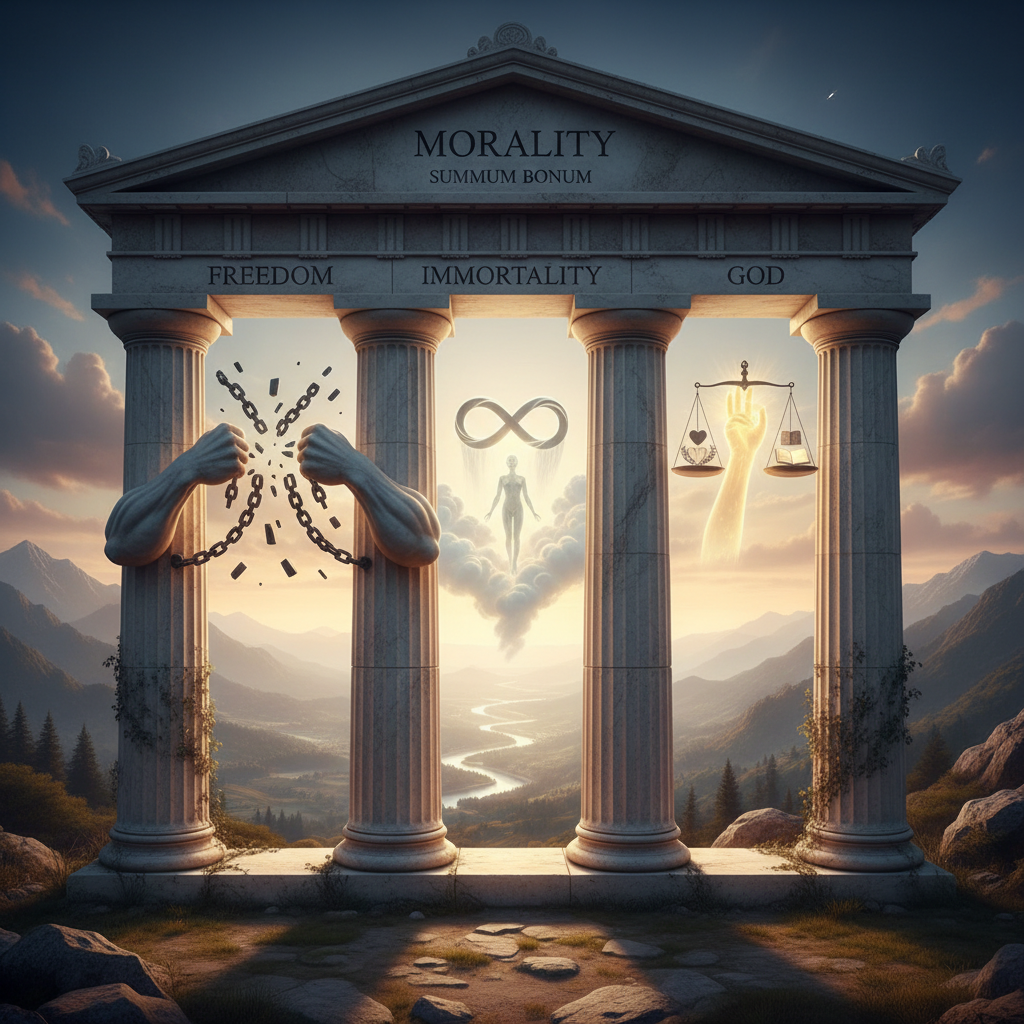
Kant believed that for morality to make sense, we have to assume three things are true, even if we cannot prove them scientifically. These are called the Three Postulates of Practical Reason.
- Freedom (Autonomy):We must be free to choose between right and wrong. If we were robots programmed to act, duty would mean nothing. “Ought implies can”.
- Immortality:We have a duty to reach moral perfection (summum bonum), but we cannot do it in this short life. So, our souls must live on forever to keep progressing.
- God:In a fair world, good people should be happy. But in real life, bad people often win. We must assume a God exists to ensure that, in the end, virtue is rewarded with happiness (summum bonum).
Detailed Explanation
What are “Postulates”?
A postulate is an assumption that you cannot prove is true, but you must accept as a necessary condition for something else to make sense.
Kant argued that theoretical reason (science/logic) cannot prove God or freedom exist. However, practical reason (morality) requires them. If we want to take morality seriously—and we must—we have to act as if these three things are true.
The Three Postulates Explained
1. Freedom (Autonomy)
The Argument:
- Morality is about duty (“I ought to do X”).
- To say “I ought to do X” implies that I can do X. It implies I have a choice.
- If I were forced by instincts or physics (determinism), I would not be responsible for my actions.
- Therefore: To make sense of moral responsibility, I must postulate that I am free.
Key Phrase: “Ought implies can.”
(You can only have a duty to do something if it is possible for you to do it).
2. Immortality of the Soul
The Argument:
- The moral law demands perfect virtue (holiness)—complete alignment of our will with duty.
- We are flawed humans. We cannot achieve perfection in a limited human lifespan.
- But reason demands we achieve it. If it is impossible in this life, it must be possible in a future life.
- Therefore: We must postulate that the soul is immortal to allow infinite time for moral progress.
3. God
The Argument (The Summum Bonum):
- The highest good (summum bonum) is the combination of two things: Virtue (being good) and Happiness (feeling good).
- Reason says virtuous people deserve to be happy.
- But in this world, being good often makes you unhappy (e.g., telling the truth might get you fired, while liars get rich). Nature does not care about justice.
- We humans cannot guarantee that happiness will follow virtue.
- Therefore: We must postulate a God who has the power to ensure that, eventually, the virtuous are rewarded with happiness.
Quick Reference: The Three Postulates
| Postulate | Why is it needed? | Connection to Morality |
|---|---|---|
| Freedom | To make “duty” possible. | “Ought implies can” – without freedom, there is no moral responsibility. |
| Immortality | To allow time for perfection. | We need endless time to align our will perfectly with the moral law. |
| God | To guarantee the Summum Bonum. | Only God can ensure that Virtue is rewarded with Happiness. |
Scholarly Perspectives
“It is morally necessary to assume the existence of God.”
Kant is concluding his moral argument. He is not saying God exists as a scientific fact, but that for the moral universe to be rational (where virtue = happiness), we must assume a divine guarantor exists.
“Happiness is the state of a rational being in the world with whom in the totality of his existence everything goes according to his wish and will.”
Defining happiness to show why it is distinct from virtue. Virtue is doing duty; happiness is getting what you want. The Summum Bonum is the challenge of making these two very different things coincide.
Key Takeaways
Not Proofs: Kant is not proving God exists like a math problem. He is saying God is a necessary assumption (postulate) for ethics to work.
Summum Bonum: This is the 'Highest Good.' It is not just being good (virtue); it is being good AND being happy. Kant says we have a duty to seek this.
The Gap: There is a gap between doing our duty (which is hard) and being happy (which is nice). God bridges this gap.
Autonomy: Freedom is the most fundamental postulate. If we are not free, the whole system of Categorical Imperatives collapses because we would just be robots.
'Ought implies can': You can only be obligated to do something if you have the freedom and ability to do it.
Immortality allows moral progress: Since we cannot achieve perfection in this life, our souls must continue to exist for us to keep improving.
Practical vs. Theoretical Reason: Theoretical reason cannot prove these postulates; they are requirements of practical reason (morality).
Nature does not care about justice: The natural world does not reward virtue with happiness, so we must postulate a God who does.
These are assumptions, not proofs: Kant admits we cannot scientifically prove freedom, immortality, or God—but morality requires them.
The postulates support the entire moral system: Without freedom, duty makes no sense. Without immortality, perfection is impossible. Without God, virtue may go unrewarded.